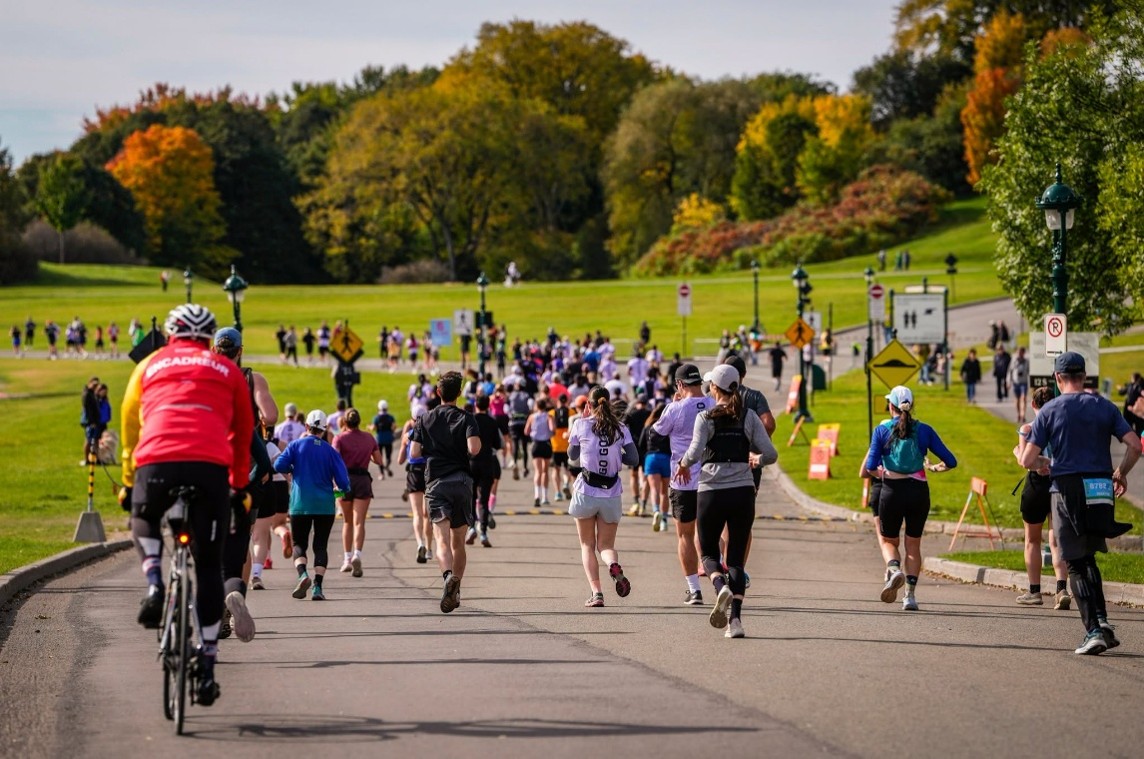
We travelled to Quebec City for the October 4, 2026, marathon (Randy) and half-marathon (Ifi).
Note: We run miles, but we’ve also converted the distances to kilometres.
Background
Ifi is training for the Athens Marathon in November, so this was meant to be a training run/race within that scope. For Randy, the full marathon was to be a test of Pete Pfitzinger’s Advanced Marathoning “18/55 plan” (meaning 18 weeks, maxing out at 55 miles/89 km).
Getting there and being there
Our overall drive went smoothly, but there were some frustrations along the way. We left 2 days before the race to give us an extra day of rest before the race. We stayed outside of Quebec City the first night (because the hotels are very pricey on that weekend), then at the Hotel Saint-Edouard – about 3 km from the race start and a 25-minute walk to Old Quebec. Although somewhat pricey, with not a lot to offer in the immediate area, the hotel was very nice, with new and large rooms. It definitely had the largest TV we’d ever seen in a hotel room!
On the way there, we took the route south of the St. Lawrence (highways 30 and 20). Google advised us to take the northern route on the way home (the 40, 640, and 50). We probably would have been better of sticking with the southern route both ways, and it would have avoided some of the Montreal traffic near rush hour.
Google directions let us down a few times, especially in Quebec City. The software would frequently take too long to re-route or even freeze up on us. If you’re not familiar with driving in the area, expect to get frustrated, even with directions. By Ottawa standards, lanes end quickly and merge lanes are extremely short. Signage was adequate, but it helps to know the area. If you miss your turn off, expect to take 4 to 5 different highways to get yourself back downtown. We were frazzled more than once.
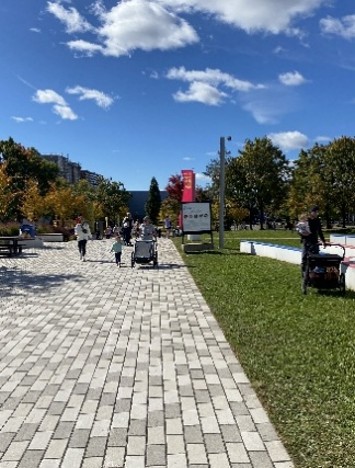
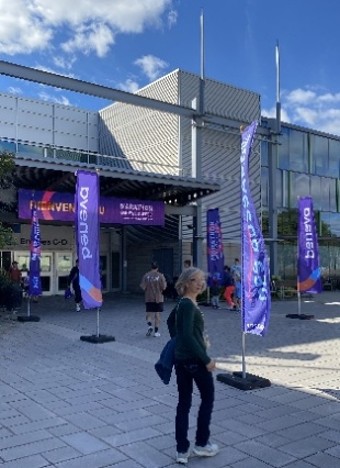
Race kit pickup was in an enormous complex (ExpoCité, Vidéotron Centre, arena, and more) near the race start and finish. We should have timed our pickup better to avoid the congestion (people and cars) related to Saturday’s 2K, 5K, and 10K runs. Parking is a whopping $17 (no in-out privileges) but the city apparently paid it for race kit pickup. We did have to pay on race day. With 4000 parking spots, it was quite a walk just to get to our bibs and back to the car. The race start and finish area is, however, impressive – a nice setting for a race. (Option: Race organizers gave 2 free bus tickets per person upon request. Some people walked or jogged there – or maybe just from a cheaper parking lot somewhere.)
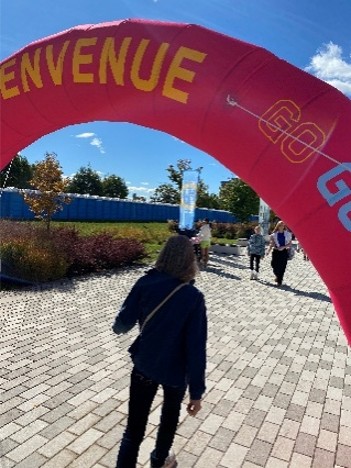
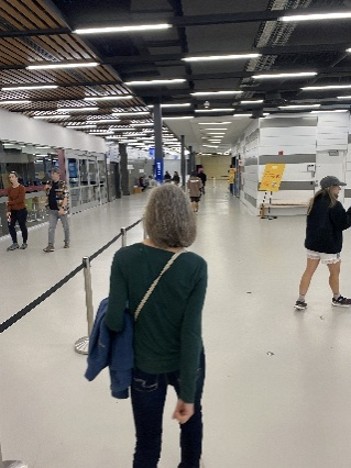
Where are the friggin’ bibs?!
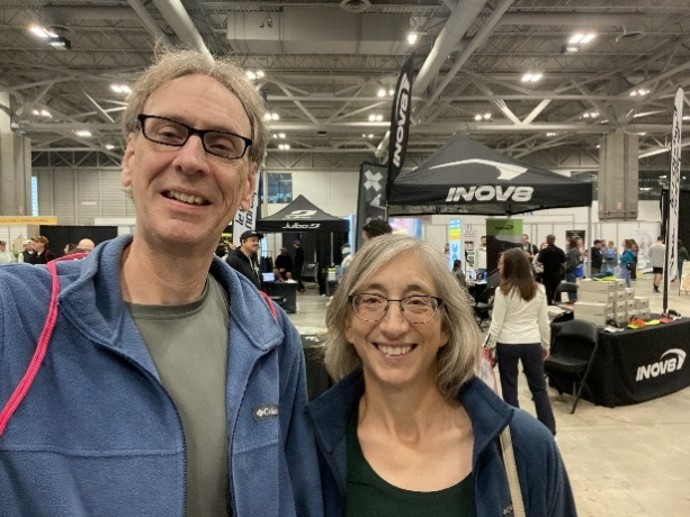
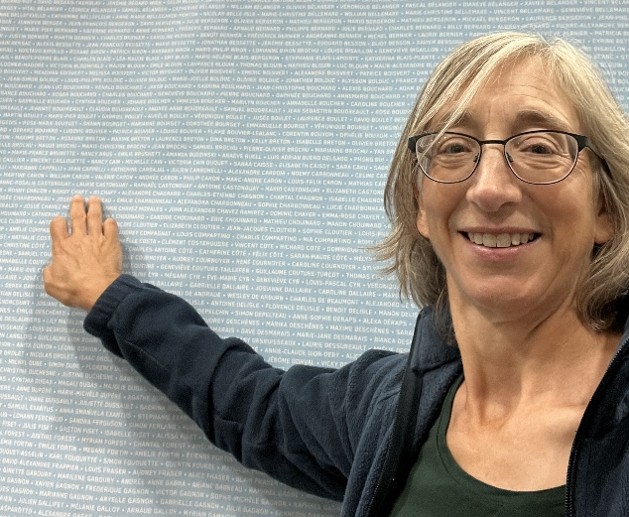
At the race expo
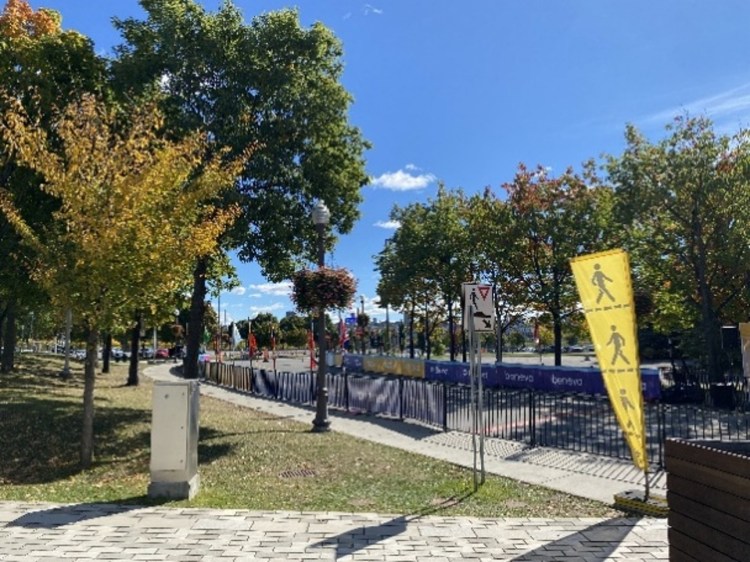
Start line area
Race morning
The weather was forecasted to be on the cold side for early October. At 7 a.m., it was sitting stubbornly at 2C, presumably rising to 11C by noon, so we had to make some decisions about what to wear. For Ifi, the 9:45 start gave her enough time to prepare for somewhat warmer weather (around 7C). For Randy, the dilemma was to dress for the start and risk overheating, or dress lightly, hope not to freeze, and gradually warm up. Most runners chose the latter. But past experience was his guide – at Georgina last year, it was closer to 9C, but the cold probably contributed to early cramping in the marathon. So, roll the dice – Randy went on the warm side, even using silk long johns for the entire race (not used since last winter). Silk is very light and breathable – a much better choice for performance than polyester-based tights. It was the right call for him, but he wishes he could have just run in shorts like a “normal marathoner.” Ifi opted for shorts, her K2J t-shirt, a bright jacket (easy to spot in photos), a hat, and disposable vinyl gloves to keep warm.
Randy’s Quebec City Marathon
I won’t talk much about the Pfitzinger plan details. For fellow K2Jers, if you’re interested in those details, send me an email or ask me about it the next time you see me. Training consisted of long runs (up to 21 miles, 34 km) and a lot of lactate threshold work, with some VO2 max training in the final weeks. I also spent a lot of time on the Corkstown Road hill, going up and down that thing too many times to count. In sum, I really liked the plan, and it prepared me exceptionally well from a general fitness perspective – even running a 44:40 10 km just 2 weeks ago, my fastest in more than 10 years. Unfortunately, because of a late illness, I wasn’t able to test the plan out for the marathon in the way I’d hoped.
My race-day prep for Quebec was similar to previous marathons; I tried to control all those little variables. And my race fueling was essentially the same: 7 gels and as much Nuun as I could carry. I did go with the caffeinated Nuun this time around, and I took a bit more caffeine early on. Did the caffeine help? Maybe. It didn’t hurt my performance, and that’s all that matters.
I had 2 pre-race worries: (1) the weather, which was manageable, and (2) my recent battle with a cold virus. I couldn’t do anything about #2, except hope that I would be okay.
My race plan was essentially the 10-10-10 strategy: 10 miles (16 km) easy, 10 miles harder, and gut out the last 10K. This seemed to suit the marathon course, which starts flat, then gets VERY hilly just past 10K until around 10 miles/16 km. At that point, the course turns downhill for several miles/kilometres, then mostly flattening out the last 10K.
Starting out, the weather had warmed to a balmy 3.9C. At that point, I was glad to be overdressed relative to my fellow runners. The weather would remain quite cool for the first half of the race. In the second half, it warmed up to 11C, but I was never hot because I wasn’t running anywhere near lactate threshold pace. I only regretted having to wear more clothing than I wanted to.
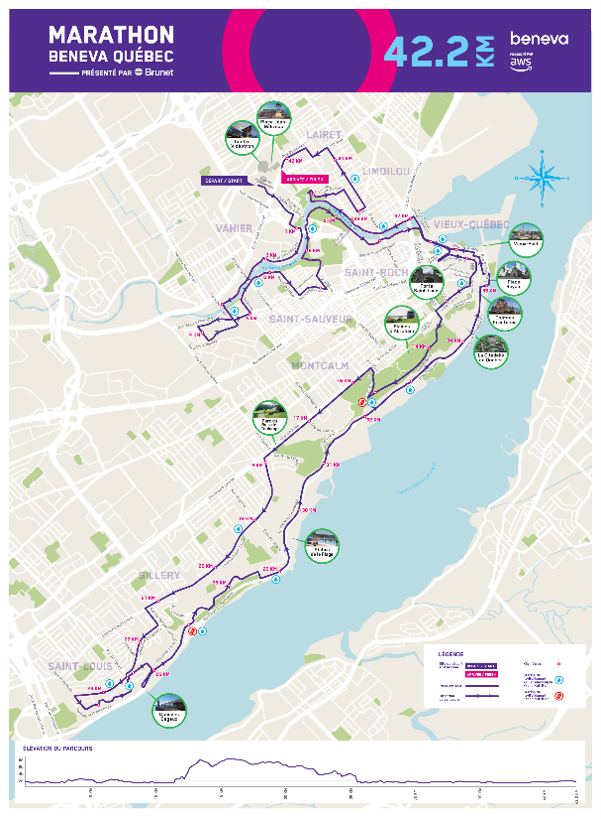
The route was beautiful for the first half of the race – the historical setting and the scenic views on a sunny day were unique to Quebec City – but the route wasn’t perfect. For a race with 3500ish marathoners (and a lot more half marathoners), I was surprised that within a few kilometres, the organizers funeled us onto recreational pathways. It was very crowded during these stretches. The other runners were considerate enough, but space was tight. In addition, I have never run a marathon with so many turns! Just take a look at the race map to get a feel for the extreme number of turns (many tighter than 90 degrees and on small pathways). Some runners complain about the number of turns at the Toronto Waterfront Marathon – but that felt like a straight line by comparison. Also, much of the second half of the course was residential, with some pathways. It was nice enough, but Ifi seemed to get a nicer route overall for the half marathon.
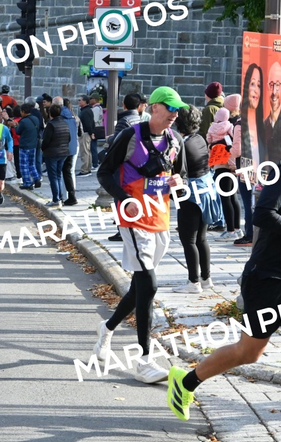
Randy at one of the zillion turns
The course was well-staffed with volunteers and spectators. Aid stations had Krono electrolytes (similar to Nuun, but with some carbs), and porta potties were available at some stations — I used my first-ever race porta potty enroute. (The start had at least 80 porta potties!) At times, the spectators were very loud and boisterous, and I almost needed to block my ears, especially when going through a tunnel on the way out. But the energy level was great, and the crowd support might have been the best I’ve experienced in 11 marathons.
The first 10 miles (16 km) went smoothly enough. I started slow, picked it up a bit, and then intentionally ran very slow on the big hills into Old Quebec. After running through a long stretch of pathways, we went into a tunnel. The bottom of that tunnel marked the beginning of a long ascent that would last more than 5 km. In the tunnel, some runners starting yelling – as if to say “the race is on!” It was funny and felt like an acknowledgement of what we were all thinking: game on.
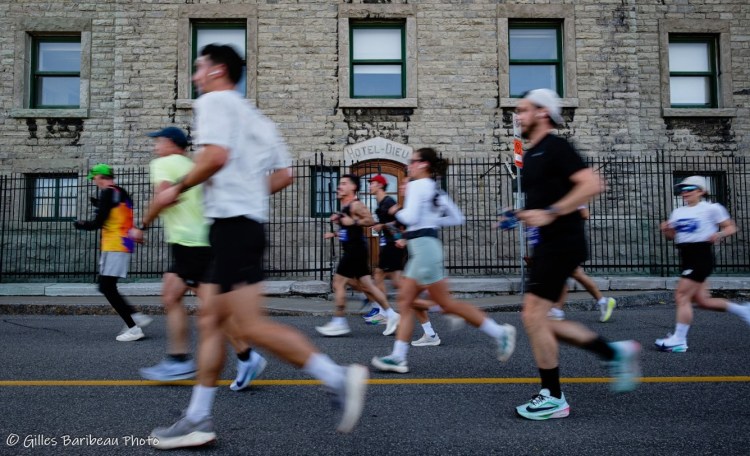
K2J leads the way!
This marathon has an elevation gain of 823 feet (251 m), by far the hilliest marathon I’ve ever run. Looking at the elevation chart, it seemed I’d be facing a roughly 300 foot (91 m) ascent, followed by a big descent, then another 80 foot (24 m) ascent. At that point, I would hit the top of the “mountain” and could begin the long descent home – with some much smaller speed bumps along the way. The chart was misleading – I couldn’t see how the course could possibly be 823 feet based the line graph. However, running it gave me some answers. The first big hill is shown as a fairly straight line up, but was actually a series of six or seven hills, with flats or false flats in between. And then the first downhill and follow-up hill were also a mix – nothing was as smooth or predictable as I’d anticipated. If you run this race, expect lots of inclines and declines throughout. Even the flat sections were never pancake flat.
My target was to hit the first 10 miles (16 km) around 88 to 89 minutes and then pick it up on the downhills. But that hill took something out of me, even running it slowly. And this is also where I started to wonder about my recovery from the cold virus. I was only able to run comfortably at 10 seconds/mile slower than my target plan. I had to accept that and just ramble on.
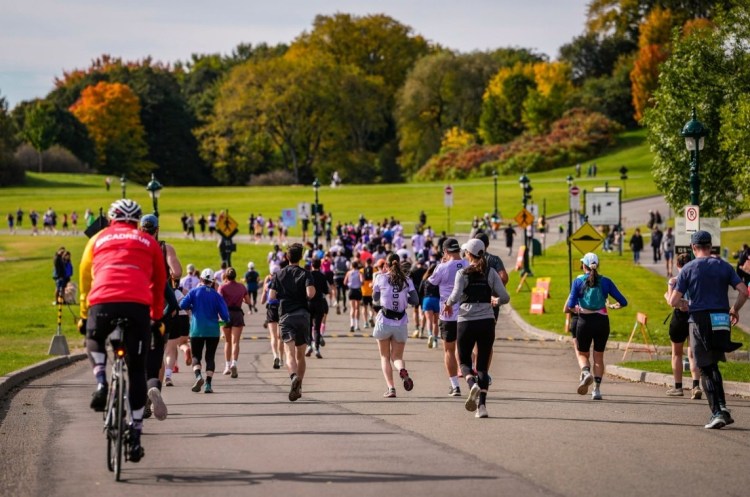
Starting the long descent
All went well enough until around 15 miles (24 km). At that point, I could sense an old foe, cramping, was probably going to make an appearance. This was a frustration: I had done several recent training runs, some very long, some fast, and a couple of long runs at marathon pace with no cramping issues. So, now that I have 11 marathons done, I can say my chance of serious cramping = 100%. What was it this time? Was it the early chilliness, the hills, or my virus recovery? Or one of a million other things? The latest research now points to a spinal component, but the research is so recent that no solutions have been found yet.
At 16.5 miles (26 km), my first full-stop hamstring cramp hit, and in a very crowded section just past the merger with the half marathoners. I was fortunate not to get hit from behind. I was upset about the cramp, so I did something unusual – I went faster when I started running again, and I kept it up for awhile. My fastest mile of the day was mile 18. I actually felt good for a 2K stretch, but I also probably used up my remaining glycogen, because I noticed my pace slowing in mile 19 and then the cramps returned – this time for good and they would become more debilitating with each mile.
The last 7 miles (11 km) were mostly flat or smaller inclines, but I was struggling with every step. That said, I’ve experienced far worse cramping and other issues in marathons, and I believe my training carried me through to the end. Yes, I had to pull up, with full stops, nine more times, stretching the best I could, and yes the wall was setting in over that last 10K, but I was able to plod along and never felt the need to take a walk break. I ran the whole stupid thing.
Be aware, if you ever run this race, there is one last significant hill coming out of the tunnel with 5K to go. It’s not particularly long or difficult, but very similar in placement to the final overpass hill at the Toronto Waterfront Marathon – late enough in the race to really feel it. One bonus distraction during this stretch was that we got to run right past the Queen Mary 2. That is one big ship!
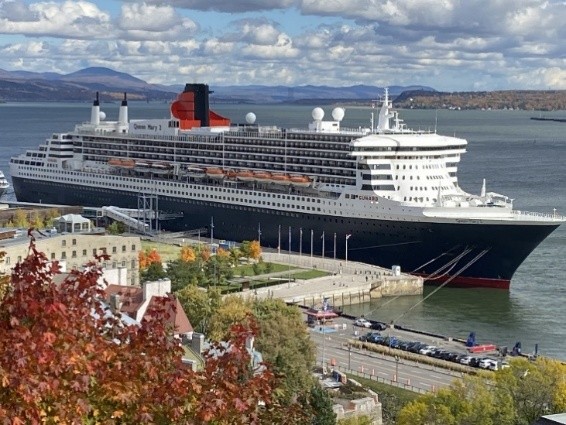
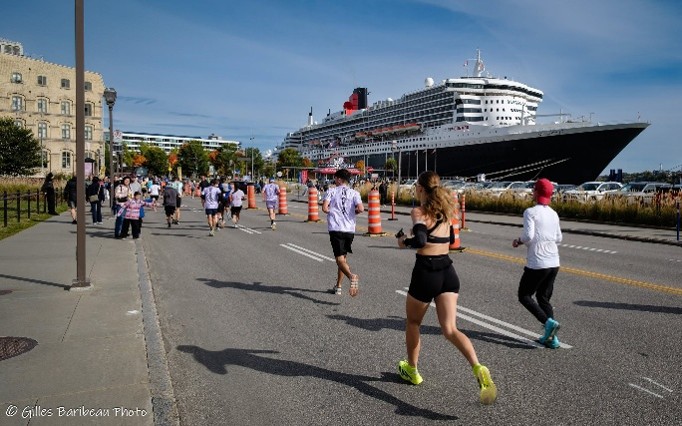
Running alongside the Queen Mary 2
Crossing the line in 3:57:02 felt like a measured success, and I can’t complain about any sub-4 hour performance at age 63. Still, I was somewhat disappointed in the time, even after acknowledging the seriously challenging course. My training and recent shorter races suggested a better result. But I know I had other issues coming into this race. That nasty cold put me into full rest/recovery mode, followed by light jogging – it felt like a full stop and loss of momentum. My congestion level and sleep were miserable for several days.
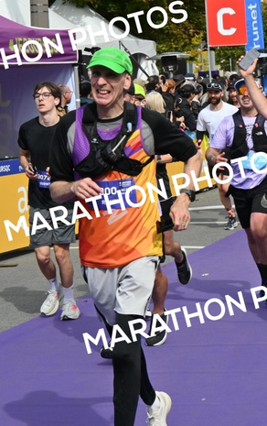
The finish line!
Race satisfaction notwithstanding, my biggest disappointment was not being able fully gauge all the work I put into the Pfitzinger plan. I went through a full 18-week training plan, but the illness during the taper took its toll. For example, I was scheduled to run stride sessions (6 x 100 metre sprints, sometimes a bit more) after 5 of my easy runs during the taper. I found the strides effective over the summer months, but I had no energy for those workouts over the last 10 days – so much for fine tuning. Not a big deal, but I wasn’t coming into the race the way I wanted.
How can a marathoner assess full recovery? I felt “recovered” for exactly 1 day prior to the marathon, but several online sources (including doctors and coaches) suggest at least 1 to 2 weeks is required after recovering from illness to reach full performance in a marathon. That said, I could find no studies to back this up, and any normal non-marathoning person would have said they were “over it.” But don’t we all know that marathon runners are not normal? (FWIW, I do plan to use a modified version of the Pfitzinger plan for the St. Lawrence Marathon in the spring.)
Would I recommend the Quebec City Marathon? Absolutely. It’s beautiful and memorable. Will I do it again? Not anytime soon. I’m not sure I want to run a marathon that difficult again, and I want to run some closer-to-home races in the coming year or two. Travel also takes something out of me, and we have good enough races around that don’t require 5+ hours of travel. If we do Toronto again, the train is a great and easy travel option. (We considered it for Quebec City, but it would have been a much longer journey there – with no easy way to get to bib pickup or the start/finish line).
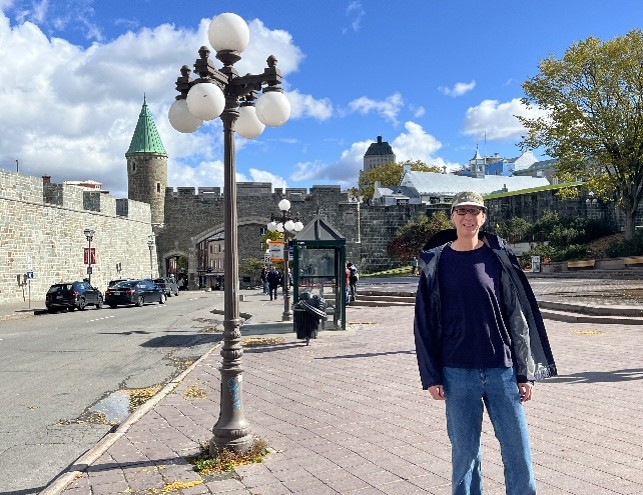
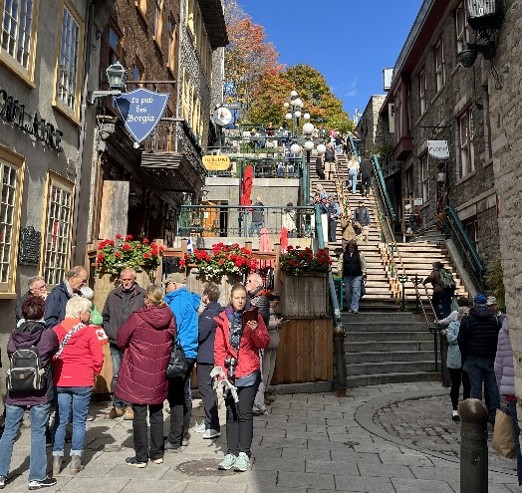
The day after, Ifi dragged me through the hilly streets of Old Quebec
you can find Ifi’s Half marathon race report here


One thought on “2026 Quebec City Marathon Race Report by Randy”