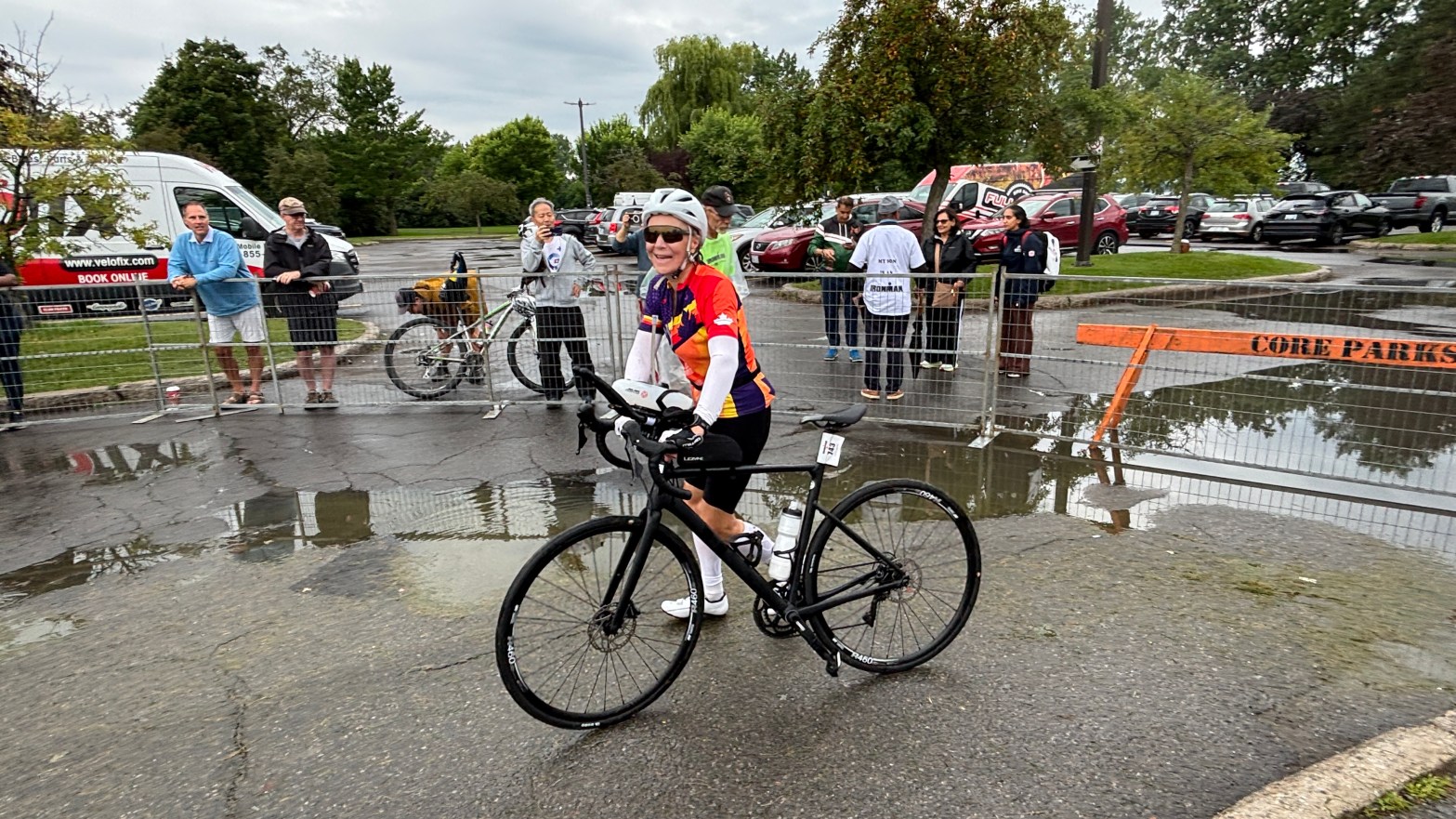
Preamble: Although the Ottawa Ironman was months ago, I hope my experience and lessons learned will help others training for Ottawa Ironman 2027 for the first time.
In January 2022, I joined Run K2J, in order to prepare for the Boston marathon. At the time a number of members were training for the Mont Tremblant Ironman. Given my age and a reasonable fear of the Mont Tremblant hills I didn’t see an Ironman in my future, even more so as I turned 70 a year later. However, fate intervened and Ottawa received the contract for an Ironman in 2025. I volunteered on the run course and saw people of all sizes, shapes and ages along the marathon route, some moving fast, some slowly, and in that moment thought that, just maybe, I could do it. Weeks later, I signed up for Ottawa Ironman 2026.
The Training Journey: I started my training at the end of October, 2025 with a coached group. I was glad that training started that early as I wanted a lot of lead time especially for the bike. I became very diligent about logging all of my workouts each week and reporting on my progress in order to receive the feedback I needed.
One of the first things I did was purchase an indoor trainer. A Run K2J friend set it up and I joined the Monday night Rouvy riding group for the winter. I was able to incorporate that into my weekly training plans. I was also enrolled in the OttawaSwimming.ca weekly group swim lessons which became part of my Ironman training as well.
Winter training was going fairly well until January when I had two injuries. I was doing pec dips off of a box when I pulled my pec muscles. It’s difficult to do a lot of things with pulled pecs – no yoga or Pilates, no upper body strength training, and at times it hurt slightly to swim. However, taking it slow, going to physio and taking care of myself, the pecs eventually healed. Later in January, I went over on my foot during an easy, outdoor run. I reverted to pool running for a couple of weeks then the treadmill and eventually ran outside again. Patience is not one of my virtues but it was required in order to heal properly.
After many months of indoor training, I was happy when spring arrived and I could move my bike and run workouts outside. It was suggested that I still do a weekly workout on my indoor trainer but I only had one bike at the time and didn’t want to keep taking it on and off the trainer. My alternative was to go to Gatineau Park once a week and do a hill workout there. In future, I would continue the Gatineau Park workouts but I now have a second bike just for the trainer so that I can do hard Rouvy workouts indoors as well all year round.
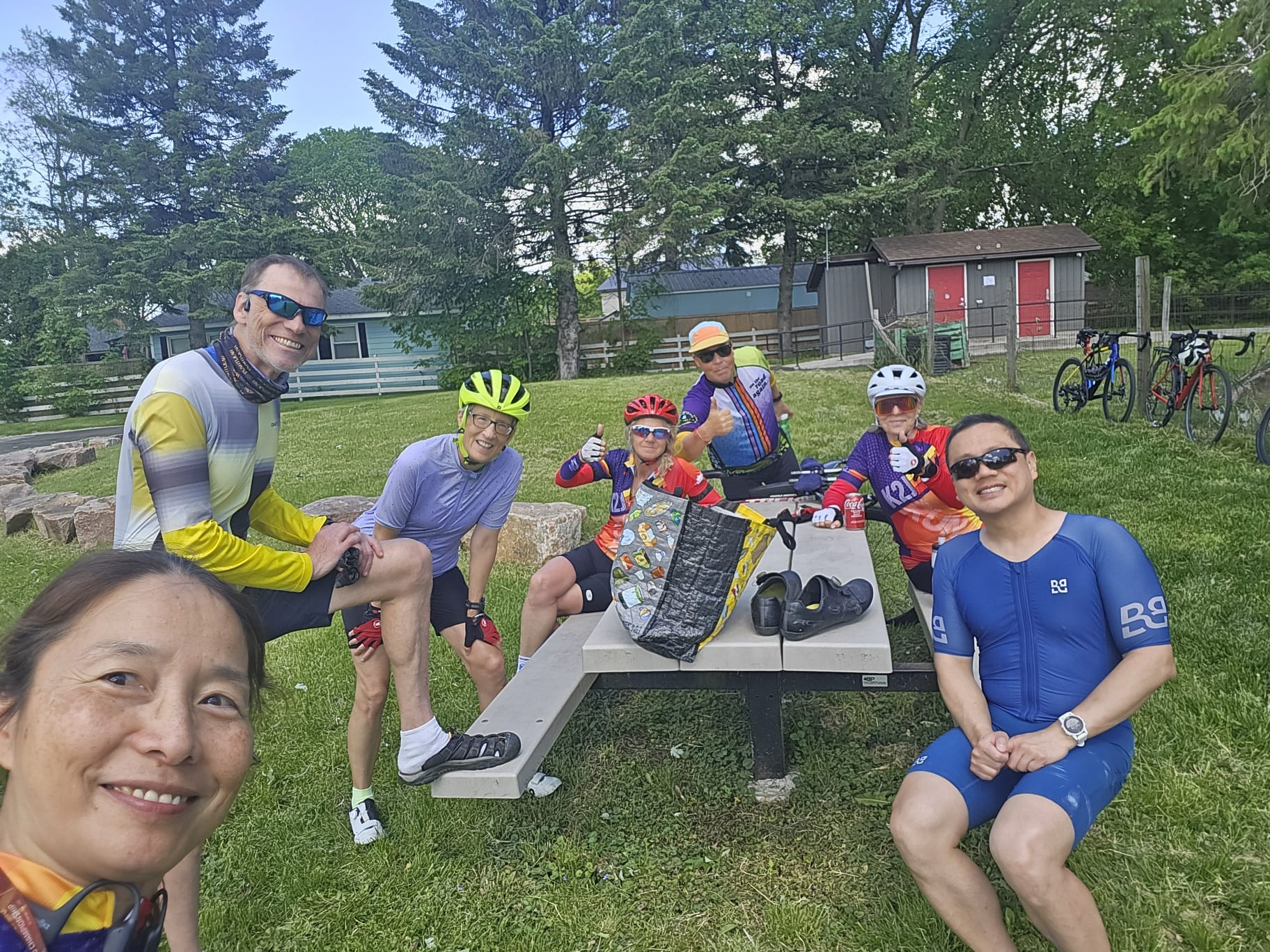
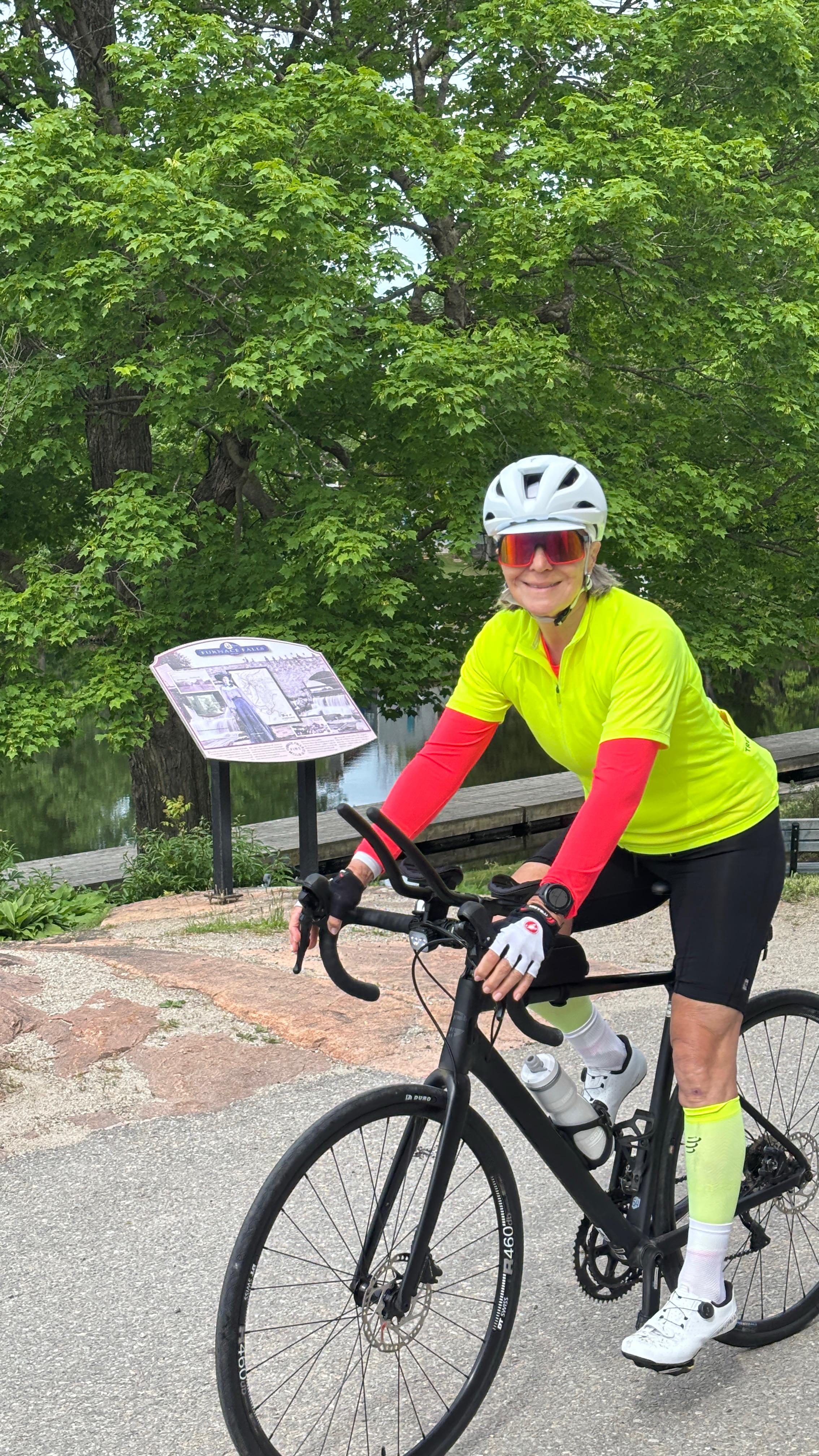
My bike training outdoors mainly took place on the Western and Eastern Parkways on Sundays when the roads were closed to traffic. Many of the workouts were on my own, although there were lots of other people around me. For the longer training workouts, there were times when I struggled to complete the entire distance, but did it anyway, and there were tears. I would take breaks and then worry that I was too slow and would never make the time cut-offs for the Ironman. Doing the 160 km cycle to Gananoque in June with the Run K2J cycling crew did help to boost my confidence. We took nicely placed breaks and I could follow the route on my watch although some Run K2J angels appeared at several turns to make sure I was going the correct
way. Despite some difficult training days overall, my intention was always to do what was asked of me in training so that when I got to the actual race, I knew that there was nothing that I had left undone. I also had to remind myself of my initial goal which was: to finish within the allotted time – period!
Being used to training for and running marathons, the biggest challenge for me initially in my running training was to SLOW IT DOWN! In retrospect I totally get why that is required for the Ironman when you just want to finish. I was constantly running at a pace faster than recommended or in Zone 3 or 4 or 5 when I was supposed to be Zone 2. I did eventually slow it down by the end of my training.
Having completed a few shorter distance triathlons in the past I was comfortable about being in open water but knew that more training in open water would serve me well. I signed up for the Open Water swim clinic through OttawaSwimming.ca, starting in June and throughout the summer. I also did many open water swims with my RunK2J buddies both at Meech Lake and at Britannia Beach. A goal for me, was to have a good swim at Bring on the Bay in July. I was pleased with my time for the 3 km swim which gave me confidence again for the Ironman.
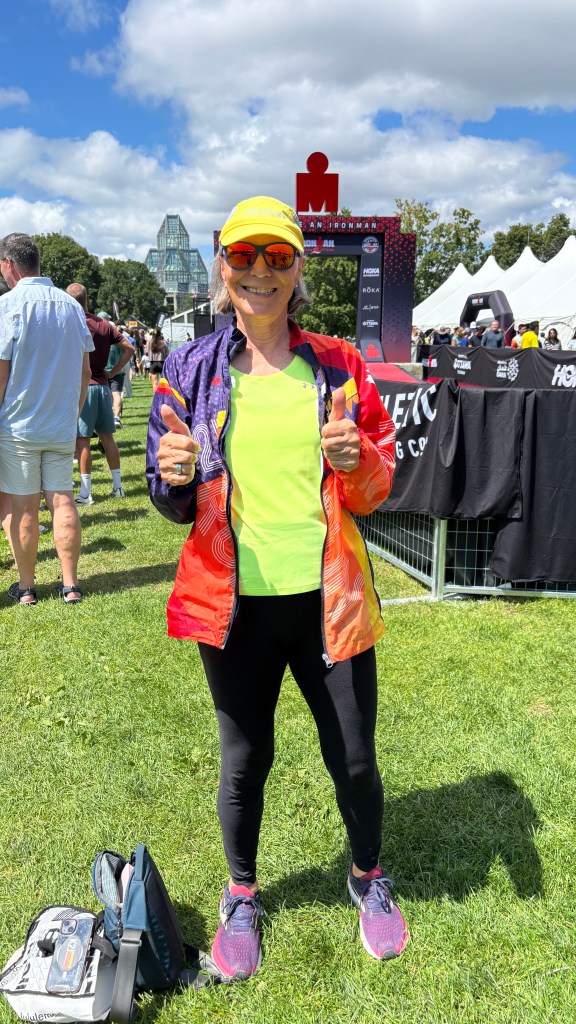
The Ironman Day: I was fortunate to have Run K2J friends dropped off my special needs bags for me so that I didn’t have to go downtown on race day and drove me directly to Britannia Beach. As I was told in training, there are actually more than three events in an Ironman: swimming, biking, running, nutrition and all those unexpected things that go wrong. When I arrived at T1 at Britannia Beach for the swim start, I could hear over the loudspeaker that the swim was “wetsuit optional” due to the temperature of the water, which meant if I wore a wetsuit I couldn’t qualify for anything other than a finish. So even before the start I had a decision to make about changing up my swim. Luckily Judy was there to talk to me about the pros and cons of each option. I decided to go with the familiar which was to wear a wetsuit and in retrospect that was the right decision for me.
Then it was off to find my bike, check my tire pressure and put my nutrition and hydration on the bike. In a moment of panic, I realized that I did not have my repair kit for the bike. When I left my bike at T1 the day before I left it off the bike because it was raining and had later tossed it in the back seat of my car where it remained. I just hoped that I would not have a flat. I knew that I had a spare tire tube in my bike special needs bag which gave me some comfort.
As is my custom, before the start I made a little request to the Universe in my head to help me to accept whatever the outcome was going to be, knowing that I would do everything I could to get to the finish but to not get attached to any outcome. And to physically fuel me, I ate half of a peanut butter and maple syrup sandwich and also a gel before the swim….a tip from one of our veteran Ironwomen. Thanks!
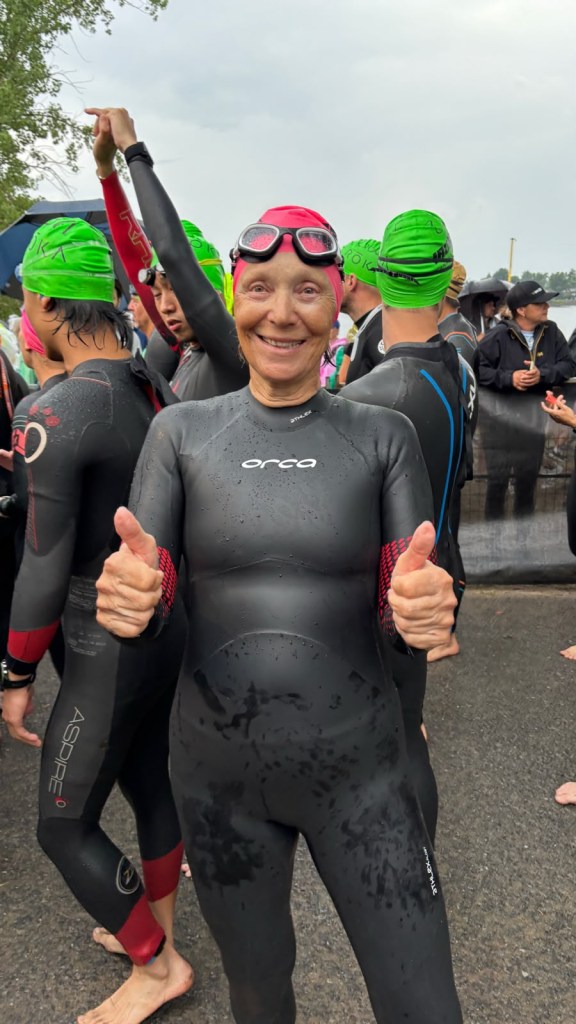
Although I expected my swim to be anywhere between 1:45 to 2 hours, I seeded myself in the 1:31-1:40 time slot for the swim. The nerves kicked in waiting to get into the water and I got quite emotional. Talking to other swimmers and getting hugs from the volunteers really helped to calm my nerves. I didn’t rush into the water and found it relatively easy to get into a regular rhythm and focus on the swim. Yes, there were others who hit and kicked me and vice versa but the open water training kicked in (no pun intended) and I didn’t let it bother me other than feeling somewhat annoyed at times.
I was happy with my swim which gave me a little boost going into T1. I had practiced my “swim to bike” transition at home several times, however, I was dry at the time. I didn’t realize how hard it is to put on dry clothes when your body is wet or damp. I had bought a new pair of rather tight compression calf sleeves a month before and had used then with no problem however with my damp calves it took forever to get them on and the poor volunteer had to use every ounce of strength to assist me. So, another lesson learned. I had decided long before the race that I was going to do a complete change in each transition, however I was expecting a hot, dry day just like last year. Beware of expectations and plan to change if need be. I had taken the predicted rain into account days before and put a rain jacket in my bike bag but did not wear it which worked out fine. I got completely wet during the bike but it was warm enough to not get chilled.
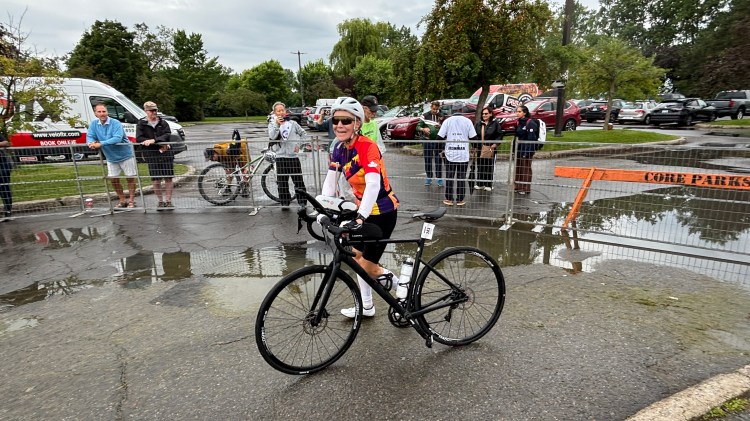
I went into the bike portion of the Ironman with the realization that I may not make the bike cut-off given my training times. However, I was rested from the taper and buoyed by the adrenaline and amazing spectator support which is huge. I felt a jolt of energy every time I saw someone I knew either on the bike or run course. For me it was like a swig of cola. It’s free energy…..take advantage of it.
My main focus was to keep going and do the best that I could. At first, I was very conscience of not drafting, but gradually I concentrated on staying in the moment, moving forward as fast I could, staying safe, and the experience. I am actually doing an Ironman….woohoo! I did have to pay attention to fuelling on a regular basis. I had wanted to save my watch battery and GPS for the run so I didn’t have an eating alert go off every 15 minutes but I managed to fuel well. In retrospect, I would use my GPS tracking during the bike. I did stop a few times at aid stations to replenish my electrolytes. I had brought my own electrolyte powder in an empty water bottle
and mixed it up at an aid station. I also had a hydration unit between my aero bars filled with water + electrolytes + carbs. I had calculated at least 60 carbs per hour for me on the bike. There was a lot of water and electrolytes available on course as well. I had practiced grabbing a water bottle while on the bike before the race and it paid off. I did stop for my special needs bag to grab my bottle of Coke and sandwich to give me more carbs and a boost which worked, but I totally forgot about the extra tire tube. Duh! Thankfully I did not have a flat.
Although there were times in training that I wanted to be somewhere else or wanted to quit when I had been on the bike for 6 plus hours in the 35+ degree heat, I was pleasantly surprised that I never felt like quitting at any time during the race, perhaps due to the cooling aspect of the rain. Completely soaked by the pouring rain, I focussed on getting to T2 and into dry clothes. I stayed in aero longer than I had ever been in training, partly because of the cut-off time stress. I had bought a new saddle a couple of weeks before even though it is not recommended to use anything new close to race day. In my defence, I had been on a quest all winter/spring to find a comfortable saddle. It was so comfortable that I stayed in aero for a long time and I believe it may have affected my run, however, it felt fine on the bike.
T2 was a little smoother than T1 for me. I kept the tight calf sleeves on but decided to wear a different pair of shorts than I usually run in, which were fine but somewhat difficult to get into. I thought I had lots of time in T2 as I had made the 5:30 pm bike cut-off by about 15 minutes. However, I was told by a volunteer I had to be on the run course by 5:30 so I had to rush in T2. I am not sure that information is correct and suggest double checking the cut-off times and rules to avoid rushing and potential needless panic.
I was ecstatic to be on the run course. I started off as planned in training, running at a very moderate pace with walk breaks. I discovered fairly quickly that this was not going to work for me but I wasn’t sure why. I spent a lot of the first 21.1km loop trying to make adjustments and find the “right” formula for me. By the first turn around at the Farm I was already stooping forward and losing core strength. I received some advice and support which I needed and appreciated, and was told that I was making good enough time and therefore, not to rush to prevent injuring myself.
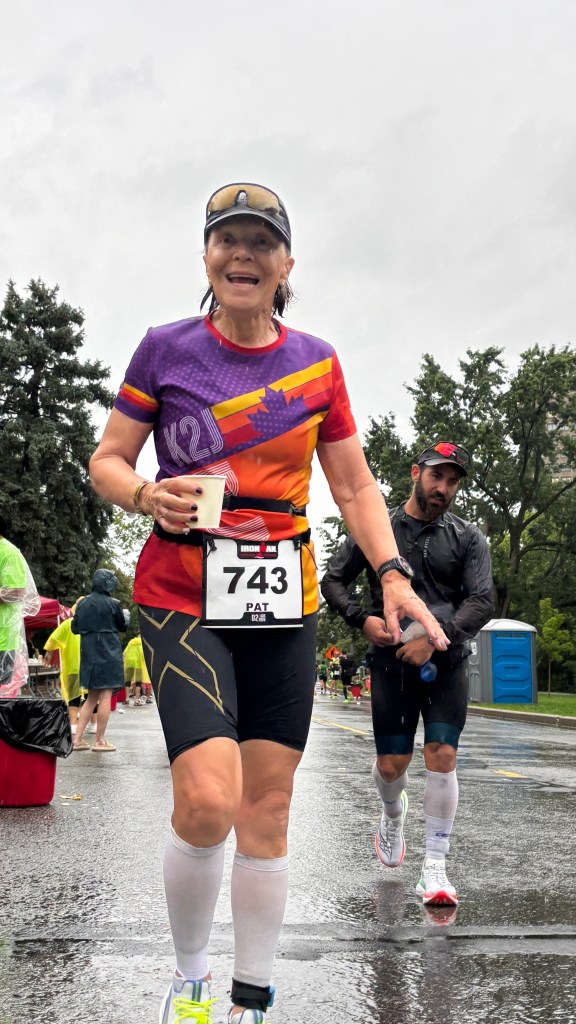
By my second loop I had a very noticeable lean to my stance as my back was tight and sore by that time. My friends and coaches along the route and the volunteers at the aid stations really helped to me to keep moving forward.
Since running didn’t seem to be working well, I started a fairly long stretch of race walking which later turned into an awkward stooped run, short walk and run again. I believe that by this time my hip flexors and glutes were locked up and weak due to hours in aero and it, along with many things I am still not aware of, continued to change my run gait. It got to the point that even when I wanted to walk, I felt I was being pushed forward and found it difficult to stop and walk at a reasonable pace. Wanting to complete the Ironman I just went with my body and didn’t resist too much. Again, spectator support from friends and Run K2J buddies, after a long day and late at night, helped me to push on, particularly that last 4 km or so.
It was truly magical crossing the finish line. I knew I had to run up a slight ramp and down the other side. I did not trust my legs at that point and at the top of the ramp they blew a lot of smoke at you for effect. I panicked a bit not being able to see so I was swiping at the smoke in order to see the ramp, which looked a little odd. However, I made it down the ramp without falling, which was my concern. I would have liked that “Rocky” moment at the top of the ramp but it is what it is. I was full of gratitude, relief, and happy emotion, seeing friends, coaches and training buddies waiting for me at the finish line. They helped retrieve my various bags and got
me home which was much appreciated.
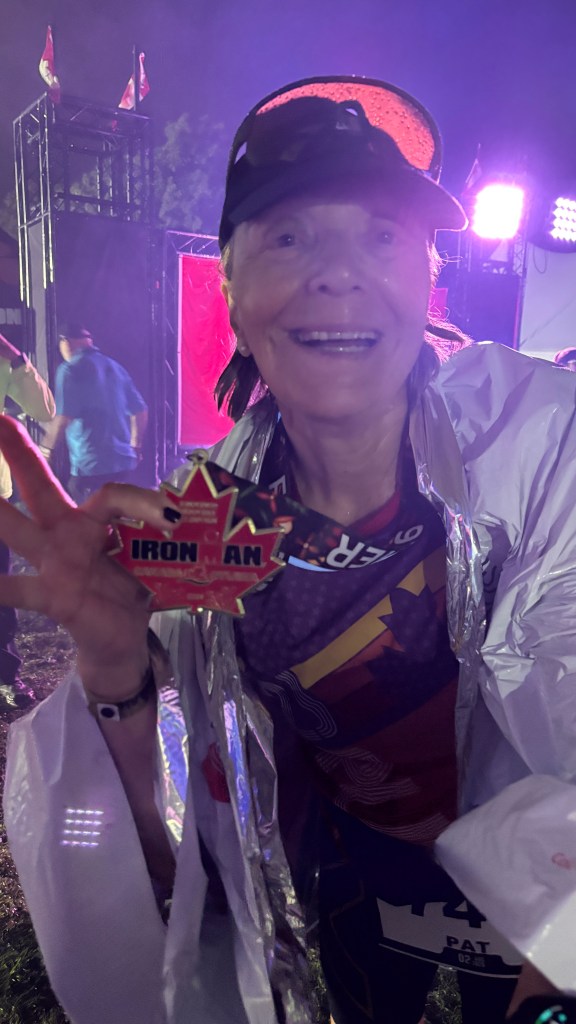
We are all different but for me, the take aways are: commit to the process; set aside the time required as much as you can given your circumstances; get a coach; find a supportive community; do the suggested training even if you don’t want to; take rest when needed and be patient, not panicked, if injured; reach out to others when in a dark place; nothing new on race day; trust the process; trust yourself; find enjoyment in the journey and be grateful for coaches, friends, family, training buddies and others who helped along the way.
Revised: October 29, 2026 by author Pat Buchik.

