If you haven’t run the Historic Half Marathon in Kingston, Ontario, yet, I fully recommend it. It’s a well-organized, certified, scenic course with good crowd support for a smallish race (456 finishers). Just be sure to hill train first.
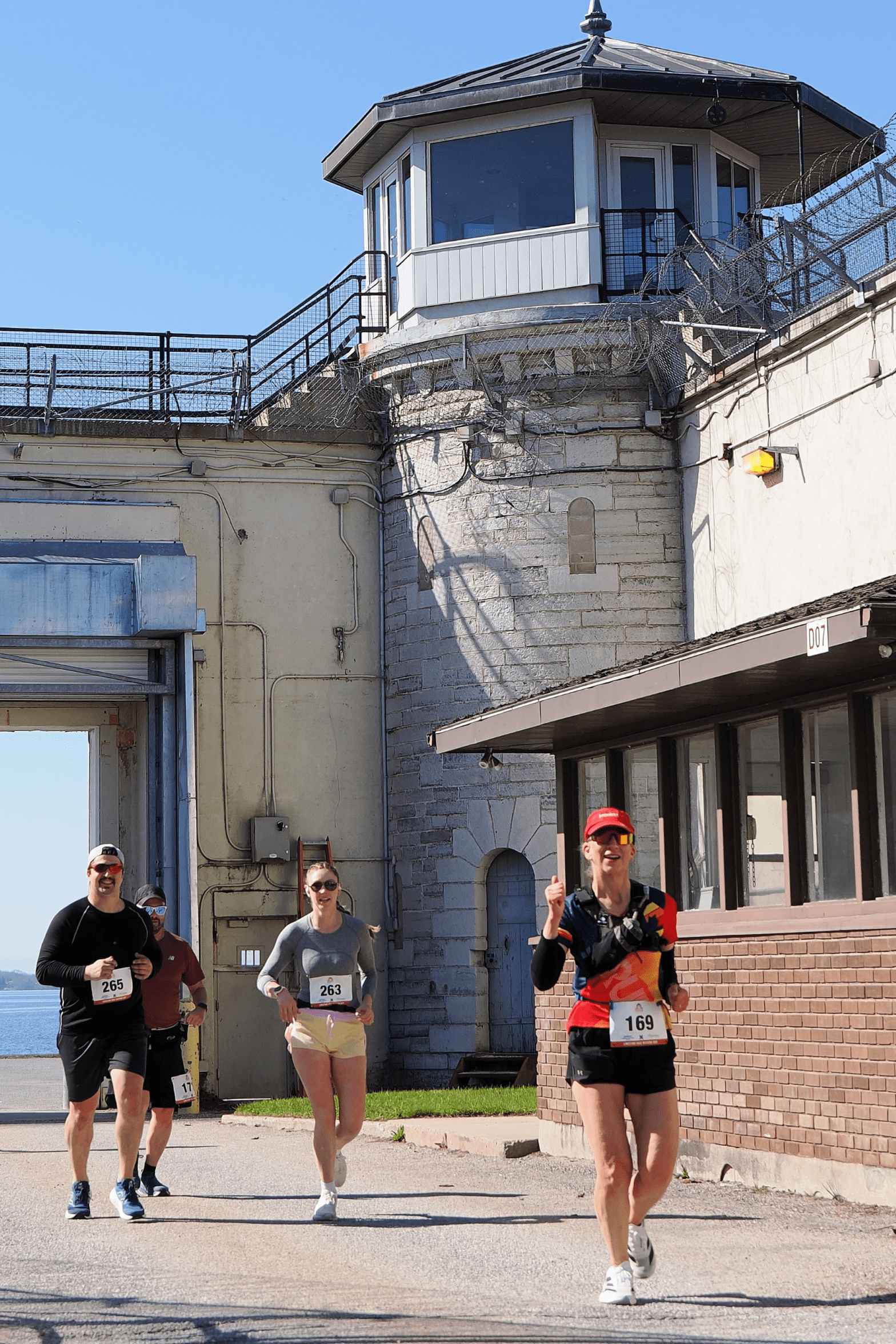
We picked up our race kit at Kingston Pen. Smooth, well organized. This location was fortuitous because we were able to see some of the hills we’d be running the next day. Forewarned is forearmed. There was also a race kit pickup downtown earlier in the day.
We were prepared for all eventualities, but the weather was perfect for a race. Sunny, not too hot, not too cold, an even 10 C with sun and light wind from the south 10 to 15 km/h. I didn’t notice the wind much during the race, but it was in our favour: lightly to our backs going up most of the hills and lightly cooling us down on the downhills on the way back. I wore a t-shirt, shorts and throwaway sock arm warmers; Randy wore a t-shirt with a light long-sleeved shirt underneath, shorts and dollar store gloves. My red cap helped Randy and Katy spot me during the race.
Kingston is a historic city, sometimes called the “Limestone City”, hence the name of the race. Similar to the St. Lawrence half marathon, which is the same weekend, the course largely follows the water. When I ran a previous version of the Limestone half marathon a few years ago, it started downtown in Confederation Park across from city hall, crossed the causeway to Royal Military College, came back into town and kept going west past the Queen’s campuses, Kingston Penitentiary, until DuPont, at which point runners turned around to come back downtown. I remember that course being mostly flat.
The course this time was a little different. Definitely a lot hillier. Total elevation gain 475 feet, mostly between 6 and 11 km (and the return equivalent). And fortunately not buggy (as it was when I last ran it). (I wore sunglasses and had brought a buff and a thin mask in case of bugs but forgot them in the hotel.) We started from the same place across from city hall, followed the path and sidewalk west along the water, bunching up at one point where the path briefly narrowed. Overall, the path was scenic, winding past the round Martello towers and Queen’s, through Kingston Pen (downhill through the parking lot to the lake, then back up again between various buildings), around Portsmouth Olympic Harbour and through Lake Ontario Park (another hill), then up (long hill) past St. Lawrence College, along Johnson St. (flat), then back downhill, around, uphill, and some zigzags to the turnaround. The course was well marked with pylons and volunteers. On the way back, runners behind me questioned which path to take in Lake Ontario Park, but I could see the runner in front of me. (An arrow or sign would have been helpful because the runners were spaced out.) They were also wary (“scared”) in anticipation of the final Kingston Pen hill. I only remember seeing a few kilometer markings, but I may have missed them. There were water stops at about the 2 km, 4 km, 7 km and 9 km (and equivalent on the way back). One also gave out a sports drink and an energy bar. Once the lead runners were on their way back, we were a little surprised at having to crisscross the road a couple times to avoid the oncoming runners.
Crowd support was very good at the start/finish, as you’d expect. It was somewhat thin elsewhere (compared to Ottawa races), but enough encouragement overall. No official music or cheering stations, but several people had stereos playing along the way, kids were high fiving runners, and a number of people had signs cheering on friends and family.
I thought I was undertrained, so I started out with the 2:10 pace bunny, but quickly realized he was more focused on catching the 2:00 pace bunny than running our pace, so a group of us smartly backed off. I felt good and decided to run intuitively, running at whatever pace I felt I could sustain and rarely looking at my watch. It was probably a smart move since the hilliness would make it difficult to run an even pace throughout. I sang Queen’s songs to myself for motivation as I ran past campus, enjoying memories. As I neared the halfway mark, I started counting the runners coming back, as I usually do to distract myself, to see how Randy’s race was going (he was the 96th man when I saw him) and to gauge my position. I then switched to counting the number of women I passed. Katy (from our Monday night Rouvy group) called out my name, giving me a boost. I enjoyed the downhills and took small steps on the uphills. Somehow the ups seemed worse on the way out, probably because the biggest lasted 2 km. The final uphill at Kingston Pen didn’t bother me at all and going down gave nice momentum into the final few kilometers. I passed the 2:10 pace bunny at some point. Being familiar with the end of the course, I knew when I could safely start to pick up the pace. Past City Park was the final left. I was now in the home stretch and able to see the red finish arch and finish strong. 2:00:59.5 My third best time ever and my PB in the 55-59 age group.
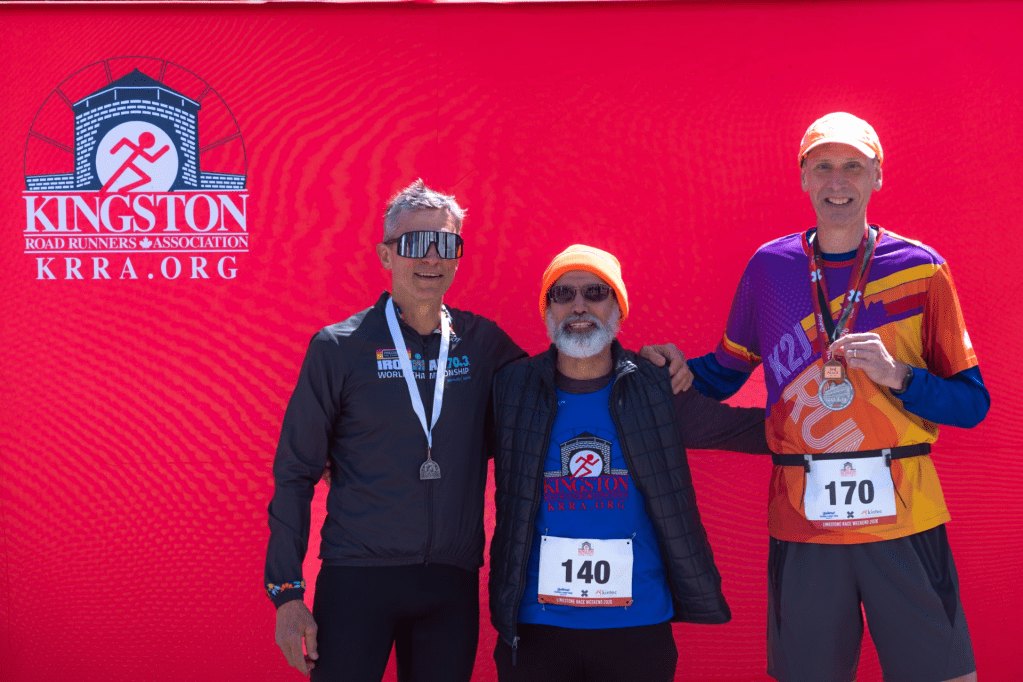
Unlike most races, this one had medals for the top 3 in each age group and podium finish photos. Randy took 3rd in his. I was hopeful but came in 4th.
What you need to know before you run this race
Study the route so that you know which version of the half-marathon you’ll be running (flat or hilly). The elevation profile isn’t posted on the race website, so you’ll need to plot it yourself.
Some years the race is very, very buggy! Be prepared with sunglasses and a light face covering (buff, bandana or thin mask).
The website said they’d only have water at the aid stations (surprising since Exact is a sponsor), so consider carrying gels or your usual sports drink. They did offer electrolytes at the 7 km station.
Beware of frustrated drivers trying to back out of driveways and potentially ignoring police at intersections.
Suggestions for race organizers
Overall the path was well marked by cones, but an intersecting path in Lake Ontario Park wasn’t marked and tangents weren’t always clear. Ideally the course would stick to one side of the road without having to crisscross back and forth—not a problem on the way out, but it is after the turnaround when outbound and inbound runners have to get out of each other’s way.
Encourage homes along the route to move their vehicles before the race so they don’t get frustrated trying to back out of their driveways and decide to back up into running traffic. Overall the police managed traffic well, but one SUV driver darted through an intersection causing Randy to slow down.

