
Randy’s Race Report
Summary
After a disappointing and cramp-filled effort at the St. Lawrence Marathon in April, I quietly decided to try another one in September in Georgina, Ontario. I didn’t tell anyone about it, not even Ifi – and only told her a couple of weeks before the marathon. I devised my own training plan, which turned out to be insufficient (if you develop your own marathon plan, you might not make it tough enough).
Unfortunately, Georgina never got beyond an “attempt.” The weather was unseasonably cool and windy for early September, and I cramped badly at exactly the half-marathon mat (which was also the half-marathon finish line). So, I decided to call it a day, save my energy, and try the marathon again the following week at Bouge Bouge in Verdun, Quebec. On a warm day, and I can’t excuse the weather, I suffered all the worst of marathoning – leg pain, cramps, the wall, the bonk – and hobbled through to a 4:12:47 finish, far slower than my 3:50ish goal.
I try to give myself 5-6 months minimum full recovery time between marathons. I also usually rest for one full week and then start light exercise in the second week. After Bouge Bouge, I thought I was done. But, being a glutton for punishment, I made the fateful decision to attempt another marathon just three weeks later. Nobody would think this is a good idea, but I wanted to test an idea that maybe I wasn’t quite done yet, so I had to try. Toeing the start line on an even warmer day (humidex hitting 29C/84F by the end), I got it done in 3:55:45, walking away feeling happy about the odyssey – and learning a bunch of stuff along the way.
So, on to the full report for each race. My goal here is not to rehash the excellent reports already submitted by my fellow Run K2Jers Terry on the Georgina Spring Fling 2025 (the same race held in the springtime) or Cameron on The County Marathon 2023, or even our own half-marathon report on Bouge Bouge Verdun 2024. I’m just going to supplement those reports with my own take on the events and my personal journey.
Background – the plan
After the St. Lawrence marathon, for which I used the Hansons Plan for training, I decided to make some changes for my next marathon effort. Ifi was deadly sick of hearing me talk about marathoning, not to mention my difficult moods during the fatiguing training. So, I decided to keep a secret; that way, nobody would need to hear me ramble on about things, nor could I complain about the training. As far as she knew, I was running a half marathon with her. I thought my caper was getting a bit suspicious when I started getting into 30 km/18 mile runs, and higher mileage weeks, but I told her I was “overtraining to be sure I’m ready.”
In reality, I was undertraining for the marathon. First off, I decided to shorten my normal training cycle by one month; I just felt I could handle this schedule better than the full 16-18 week cycle I normally did. Second, I tried to take the best elements of the Hansons Plan and combine them with Judy’s Run K2J plan to come away with a perfect plan for me. Hansons emphasizes tempo and strength running, deemphasizing the long run, while Judy’s is a more traditional plan based on the benefits of LSD. So – and don’t shoot me – I decided to alternate weeks, doing a long LSD one week, and then a long tempo the next week, combined with speed work and easy runs. I also targeted an 80/20 approach, where 80% of my mileage was easy – an approach championed by people like Matt Fitzgerald in Run Like a Pro Even If You’re Slow. My plan ended up being 78% easy, with more easy mileage than Judy’s plan, and much more than Hansons Plan. Weekly mileage was a bit higher than Judy’s and a bit less than Hansons (but over fewer weeks, so less total mileage overall).
Georgina (September 7, 2025)
I’ve been looking at Georgina for a couple of years; I knew it was fast and gets great reviews. After struggling on the hills in St. Lawrence, I was keen to try a flat-and-fast marathon, though I was concerned that the early September date would be too hot. (Just the opposite, it was unseasonably cool, with temperatures in the 9-12C/48-54F range and very cool 18 km winds off the lake.) If the race went poorly, my back-up plan was to try again the following week at Bouge Bouge Verdun.
For anyone interested in Boston Marathon qualification, Georgina is a rare “double dip” marathon, meaning it falls on the one week during the year that could allow you to qualify for two Boston marathons. The Erie Marathon in Pennsylvania is another one.
Getting there
Georgina is a 4 and ½ hour drive from Ottawa; give yourself 5 hours, including stops. We decided to get there on Friday to be sure we were well rested for the Sunday race. We stayed at large hotel in town, practically the only one – which was fine. As Terry wrote, it’s a pretty area and a nice small town event that attracts a lot of good runners.
Pre-race prep
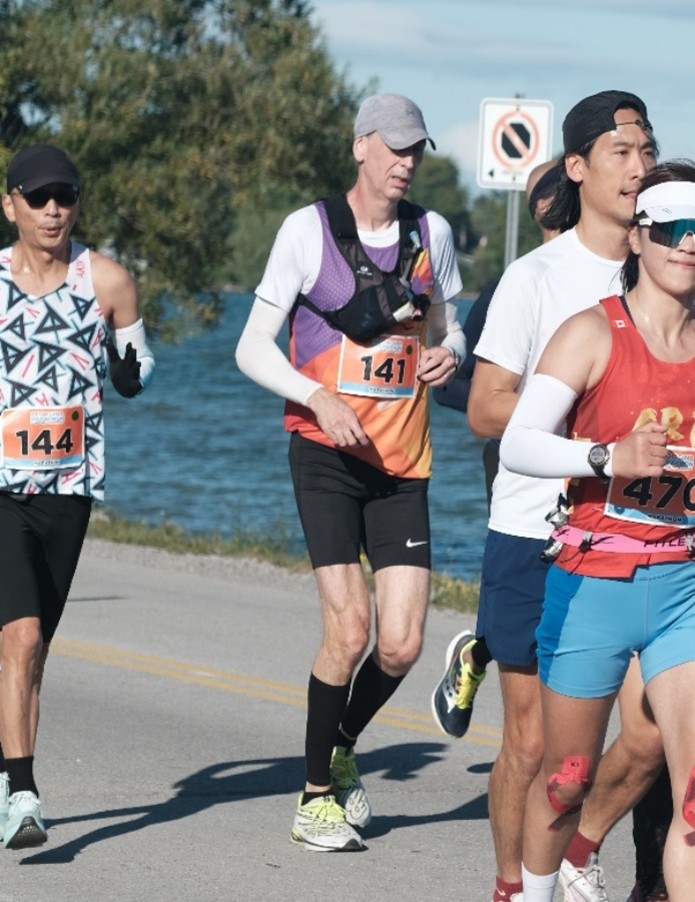
With a cool and windy forecast for the 7:30 am start time, I wanted to err on the side of being warm to ward off my old enemy – cramping. After a lot of reading, I became convinced that compression-type gear would do the trick (for warmth when not sweating, coolness when sweating, and better blood flow). I had experimented with this gear somewhat over the summer months, and I did notice a cooling effect. For a bit more warmth, I decided to wear a compression shirt with my K2J singlet layered on top. I went with half tights, arm sleeves, calf sleeves, and silk gloves. I felt relatively comfortable at the starting line.
For shoes, I went with my New Balance FuelCell SuperComp Elite 3 supershoe. I had used these at St. Lawrence, which wasn’t a successful race, but I still felt good about the shoes.
The race
Held on the south short of Lake Simcoe, the course is a double out-and-back, meaning if it’s not going well at the half marathon, you can call it a day. That temptation is not a good thing if completion is your primary goal.
The course was very flat; only one slope near the 13 km/8 mile mark started to feel more hill-like, but it was minor. For me, the bigger challenge on the day was the chilliness. We started out into the wind, and it was gusty at times. The half-marathoner and the marathoners start together, and it was relatively crowded at the beginning.
At 10.5 km/6.5 miles, I turned out of the wind and felt relatively good. I was holding steady at my targeted 5:17 km/8:30 mile pace. By 16 km/10 miles, I started to feel uncomfortable, noticing a hint of pending leg cramps, along with some TFL (part of the hip flexor) soreness. The shoes weren’t feeling good either; I’m a heel striker and I felt like these shoes might be better for mid- or forefoot-strikers. Still, I rambled on towards the half-marathon finish and marathon turnaround. The thought of pushing through another leg of cold wind didn’t appeal, and I pretty well knew that it wasn’t going to be my day as I approached the turnaround. Compression gear was a bad idea!!
Still, as I got to the decision point, a race official directed me to the marathon turnaround and I headed back out….for only one step! I literally took one step off the timing mat and got a big hamstring cramp. Tons of people standing there at the finish line, and I’m stopped dead working out a cramp. I turned to the official and said “I’m done,” and just crossed over the main finish line, feeling a bit shocked by the suddenness of my withdrawal. I did not take a half-marathon medal, andas just wandered back out to watch Ifi finish.
Ifi got through it in 2:03:42. She enjoyed her half marathon, and the found the conditions good. I think she was right; it just wasn’t right for me, for a marathon, on that day.

What I liked about Georgina
This is a very fast and nice course. If a fast marathon is your goal, put this one on your calendar – but the weather is more likely to be too warm than too cold.
The organization seemed great. Plenty of water stops, etc. Nice race shirt and medals.
What could be better
The road is relatively narrow, and the race is somewhat crowded on the first leg. I had to pass some people on the shoulder.
For whatever reason, I didn’t like starting with the half-marathoners. I expected that most of the runners around me would disappear by the second half, as they do in Toronto Waterfront Marathon, but that’s such a huge race that it has a different feel overall.
No parking on site. You need to take a shuttle bus. No problems with that, but also not as convenient as some other races.
Bouge Bouge Verdun (September 14, 2025)
Ifi and I ran the half marathon at this event last year, so we knew what to expect. This year, I did the marathon, while she ran the 10K. The course is set over a 10.5 km/6.5 mile loop through a nice park on the St. Lawrence River.
The weather was virtually identical to the previous year, meaning a bit too warm for the marathon: full sun and 17-21C (63F-70F), with a finishing humidex of 24C (75F).
Getting there
Verdun is a 2.5 hour drive from Ottawa. We arrived the day before the race, staying in a different hotel this year (a Best Western in Brossard). The hotel’s location worked better than where we stayed last year – the drive bypassed the heart of Montreal and the area around the hotel had plenty of restaurants.
Parking for the event was challenging; Ifi dropped me off for bib pickup while she found paid on-street parking. (Surprise, all municipal parking in Montreal is now via an app or a website. Last year it was free.) At least she had some time – her 10K started 3 hours after my race.
Pre-race prep
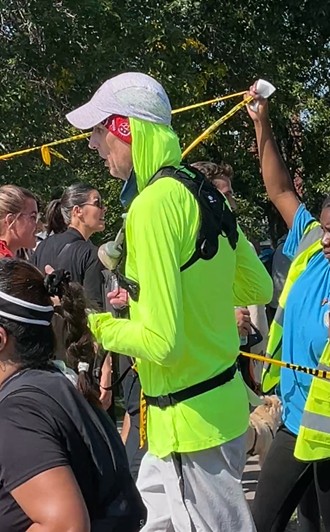
With the warm forecast for the 7:30 am start time, I focussed on keeping cool. I wore a sun shirt (with a hood, believe it or not) that I’ve been using over the summer. I also used Chill-Its for my neck and head.
For shoes, I changed to my daily trainers (New Balance 880, v14), feeling I had better results in my training runs than I did at Georgina. These shoes are a bit heavier (8.9 oz is the published weight) than racing shoes, with no carbon plate, but I was aiming for comfort.
The race
I knew this would be another flat-and-fast marathon, though not quite as flat as Georgina. There would be a 3 km/2 mile stretch of an uphill slope, not really a hill, but I had to do this four times, each time getting more noticeable.
The notion of running a marathon over four laps isn’t really enticing, but I liked the half marathon event in 2024, so I thought I could manage it. The main issue is overcoming the temptation to drop out at each lap – especially the final one. Of the six runners competing in my age group, only three completed the event.
Once again, I targeted 5:17 km/8:30 mile pace. I got through the first two laps just fine. I got my first cramp at 20 km/12 miles, which wasn’t good, but it was brief and I swished my mouth with Hot Shot – a concoction designed to relieve muscle cramps on the neurological level (going beyond simple training, strength, or electrolyte imbalances). I can’t say it worked, but I didn’t have another cramp for the next 45 minutes or so.
At 25 km/15 miles, I actually felt good, but by the time got into the uphill slope on the third lap, I started to hit the wall – rapidly. I got my second cramp, far more serious, at 27 km/17 miles. Again, I swished with Hot Shot, but it seemed to have no effect this time around. My pace slowed a bit until 31 km/19 miles, at which point everything hit at the same time – leg pain, cramping, and the wall. I struggled through the end of the third lap, saw Ifi getting ready to start her 10K, said “I’m done” and then hobbled – more walk than jog – the last lap. This was a full bonk, a complete shutdown.
For most of the race, I consumed uncaffeinated Clif Bloks. At 35 km/22 miles, I choked down a single caffeinated gel. (I’d only experimented with caffeine in one previous marathon.) By then, I was very dehydrated from not refilling my water bottle in time and not drinking enough at the previous water stop. Oddly, either from the rest or maybe the caffeine, I felt a bit better the last 3 km/2 miles and was able to jog some. Ifi had already passed me and finished her race by this point and was having a massage while waiting for me at the finish line.
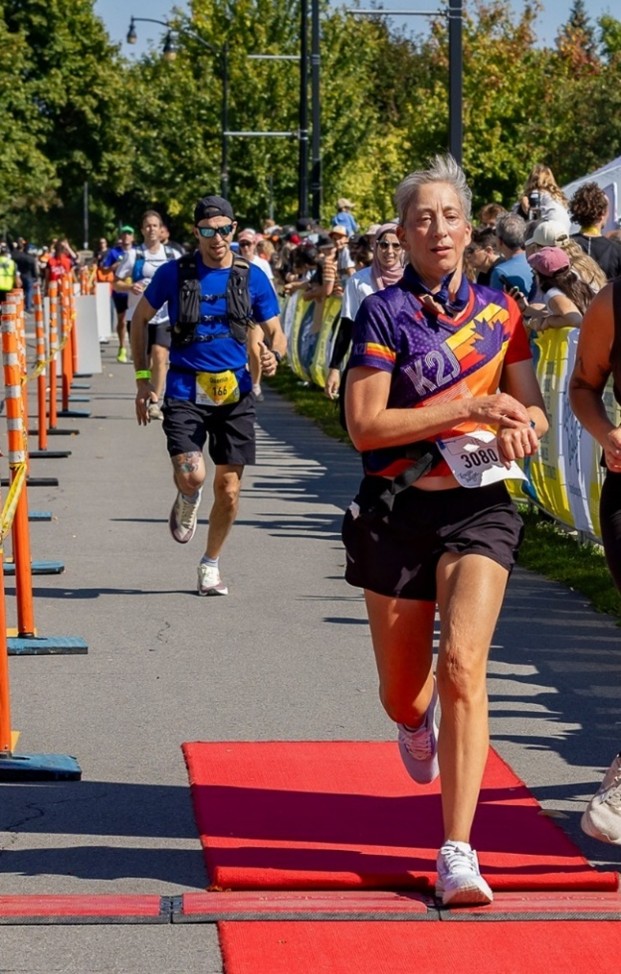
I finished up in 4:12:47, more than 20 minutes slower than my best pre-race hopes. Ifi ran her 10K in 55:27, finishing 4th out of 19 in her age group.
What I liked about Bouge Bouge Verdun
This is a nice course, even over four laps., with plenty of shade. If a fast marathon is your goal, this is another one to consider. But again, it might be on the warm side. It’s also a Boston qualifier and is well measured. Lots of crowd support as well.
Plus, and a big one here, if you have a personal helper, as I did with Ifi, you can get support at each loop. She had electrolyte refills and gels to swap out, as well as Chill-Its for the heat. I didn’t need to run with much – a big plus. Unfortunately, because of her race start timing, she couldn’t help on my last lap.
What could be better
The 10K race started shortly after I started the fourth loop. The pathway is narrow, and I was struggling, so I felt obligated to walk off on the shoulder of the path to let all the faster runners go. It wasn’t a good position to be in. Not a good feeling.
Although the water stops were sufficient (four stops per lap, two at each end of the loop), the race had one major difficulty: the last water stop on my fourth lap ran out of cups. This might have caused a big problem for the remaining marathoners finishing up in the heat, not to mention the 10K and 2K runners still on the course.
The volunteers, all very young people, were holding the bigger bottles and dumping out the precious water on runners who requested a splash. In my case, I was lucky enough to have a water bottle in my pack and just had them fill it for me.
The County Marathon (October 5, 2025)
After Bouge Bouge, I was done. I just felt that the marathon wasn’t the race for me. I told Ifi that this was the logical end to my marathon experiment. I wanted to focus more on shorter events, up to a half marathon – stuff that I felt more confident about. So, that was that.
As with past marathons, I planned to take one week off completely, then do some cycling on week 2. I also wanted to get some delayed yard work done. We signed up for the 9RunRun in Ottawa at the end of October, along with our son, Ben. I looked forward to running the 10K, while Ifi and Ben signed up for the 5K.
For the first couple of days post-marathon, I went for short walks. I felt better than usual after a marathon, but still obviously sore. By the third day, maybe just out of frustration, I decided to jog for 2 km/1 mile instead of walking. It was slow but surprisingly okay.
While doing some yard work afterwards, I couldn’t help but reflect on my disappointment at Bouge Bouge. I felt kind of depressed, even old – at some point, you’ve gotta acknowledge the years, right? On the other hand, I thought hard about my training, and how it probably wasn’t challenging enough. I felt I did a lot of things wrong:
- I shortened the cycle (duration in weeks) too much
- Instead of coming up with the best of two training plans, I cherry-picked what I wanted to do, and then rationalized it as a quality plan. I realized that in previous plans, I completed quality/substance runs at least three times a week. Somehow, my plan got that down two times a week. And by alternating tempo and long runs, I took away 50% of the weekly tempo and the long runs, essentially replacing those miles with easy miles.
- I eased up on my training effort. For years, I have used a tempo training target pace of 5:11 km/8:20 mile. This time around, I used 5:17 km/8:30 mile. I didn’t need to make this change – I can handle the faster pace in training. But because I set a slower race target, I matched my training pace to that. (Note that I use the word “tempo” to refer to marathon pace, which is how it’s referred to Hansons Plan, although I’ve since learned tempo is faster in other plans.)
So, I thought, what did I expect? If you don’t work hard enough, don’t expect good results. It is what it is. And this is why I didn’t even feel physically all that bad. I hadn’t even worked hard enough during the marathon to result in much lingering pain. And that was the epiphany! That was the moment when I started to think, “Hey, wait a second, is it possible, just possible, that everything I’ve done to this point, is still additive – that the Bouge Bouge marathon was essentially one long tempo run followed by a 10K hobble?”
How could I test this crazy idea? Ifi was off camping, so I couldn’t talk to her about it. So I thought, “If I’m right, I’ve taken a couple of days totally off, and I should be able to run more-or-less normally.” I put down the hedge trimmer and put back on my Garmin and my running shoes. I decided to run at a moderate pace, not a jog, for just 3 km/2 miles. And that’s what I did; I ran at 5 min/km (8 min/mile) pace, and felt okay. Wow! But I still wasn’t convinced, and I wasn’t signing up for another marathon just yet.
The next night, I showed up for speedwork at K2J. Yvonne said, “What are you doing here? You just ran a marathon.” I told her I kind of felt like I hadn’t really run a marathon, and I wanted to see how I’d feel. I got through speedwork fine, almost like any other training day. On the drive home, I blurted out to Ifi, “So I’m thinking of doing another marathon in a couple of weeks.” Knowing me, she just laughed and asked, “Where?”
And once that decision was made, there was only one marathon option left on the table. Toronto, Hamilton, Niagara Falls, and a bunch of other marathons were all sold out. I was hoping to get more rest first, but the only option was The County Marathon in Prince Edward County. It was exactly three weeks after Bouge Bouge. This is not a good idea, I thought, and it might end very badly, but I have to try.
This race was never on my agenda. It’s not particular flat, and, as Cameron wrote, the 2023 race was a disaster. They ran out of water at 26 km. Not good! But this year’s was one of best races I’ve ever been part of – impeccable.
Getting there
Cameron had recommended staying in Belleville, and that was a great call. It’s is an easy 2.5 hour drive from Ottawa. We went down the day before the race and stayed for two nights, to be able to enjoy wine country. We had an easy 30-minute drive to the start line.
Pre-race prep
The weather forecast was strange and challenging, going from 11C/52F to 23C/73F (27C/81F humidex) over four hours. How to dress for that?
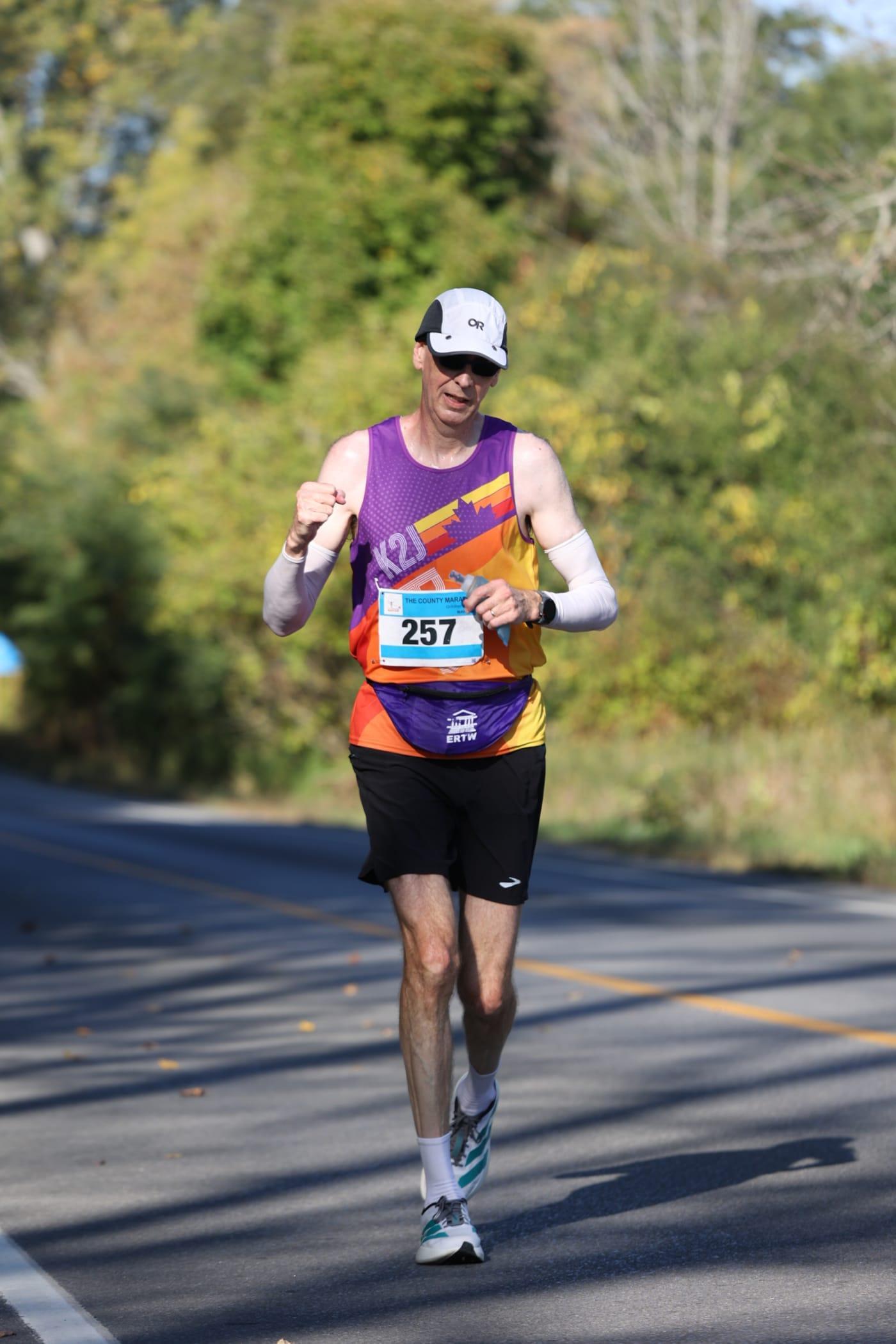
With the warm forecast overall, I wore a singlet and left my trusty water pack in the room. I used a handheld bottle and a small waist pack for gels. I had to trust that the organizers solved the water stop issues.
Given the cool forecast for the 8 am start time, I wore disposable gloves – the cheap blue latex ones. Ifi did this at Georgina, and it worked well. I brought my arm sleeves (marketed as cooling sleeves), but I doubled them over at the start for some warmth the first few kilometers. I found out later that the starting temperature was closer to 15C/59F, so this was all overkill. No matter, I disposed of the gloves by 5K and unfolded the arm sleeves shortly after that.
For shoes, I tried something new: the Adidas Adizero EVO SL. These are really interesting shoes. They are fairly lightweight (advertised as 7.9 oz), but have very high energy return in the foam. There is no carbon plate, but somehow they’ve managed to put a good and bouncy foam into a non-plated shoe that remains fairly stable. And it works for heel strikers too. I tried them on a 16 km/10 mile training run, which was enough to convince me to try them in the race.
The race
I skipped the shuttles and had Ifi drive me the Lehigh Arena in Wellington for the start of the point-to-point race, which runs from Wellington to Picton. The arena had plenty of bathrooms, and I had no trouble accessing one, arriving only 20 minutes early.
Before the race, I snuck in two weeks of training using the Hansons Plan. Far from perfect, and my overall mileage wasn’t what it should have been (particularly since I had very light running weeks prior to Georgina and Bouge Bouge.) But I felt I was heading in the right direction to take – and I ran those final days the way I should have been all along – faster tempos, extended speedwork, etc. I worked as hard as I could, but still gave myself a fairly easy final taper week.
After my challenges at Bouge Bouge, I slowed my target pace to 5:26 km/8:44 mile, hoping that the slower pace might extend the inevitability of hitting the wall. I also set a primary goal of just breaking 4 hours, with a stretch target of 3:55.
The first part of race winds through lightly rolling roads on Lake Ontario. Quite nice. It was cool at this point in morning. By 10K, the course shifted to the southwest and warmed up considerably. By the half marathon, the sun and temperature were uncomfortable and many runners were walking – maybe the most I’ve seen at that point in a marathon. The second half was much tougher because of the rising temperature and persistent humidity.
Despite my slower pace target, I was feeling it by 26 km/16 miles. The edge of the wall started to creep in. I got my first cramp at 29 km/18 miles – the farthest I’ve ever gone in a marathon without cramping. Again, I swished the Hot Shot elixir and got in another 5 km before things got worse. But my pace remained on target, and only gradually slowed after 30 km. This was a key difference between previous recent marathons: I started to feel bad fairly quickly, but I didn’t slow down nearly as much, and my decline was more-or-less orderly. (BTW, I completely forgot to use the Hot Shot for my second and the many subsequent cramps.)

Through it all, the course organization was top-notch. The water stop support was second only to Boilermaker. Water stops (water and BioSteel electrolytes) were every 3 km through the half marathon and then every 2 km in the second half. And porta potties at every stop. Sponges nearer the end, along with at least one sprinkler and another shooting us with a water gun. And they handed out GU gels at some stops. The stops were so frequent that they became an easy goal target over the last 10 km – I told myself, “just make it 2 km to the next water stop.”
The last 5 km got really tough. The course has an overall elevation profile similar to St. Lawerence, with two notable exceptions: (1) this marathon is mostly gradual slopes, of which there are many, with almost no sharp-and-short hills like St. Lawrence, and (2) the hill at 37.5 km/23 miles is a killer. There is nothing even close to that hill anywhere else on this course. The placement is the real gotcha. You come around a corner and see this big hill 800 metres in front of you. The guy behind me said, “Oh my God!” Although it’s a flat and straight stretch before the hill, a lot of runners just started walking – it was like saying “no way.” I forced myself keep going at least until the hill. Playing mind games with myself, I actually made it up the damn thing before taking a very short walk break.
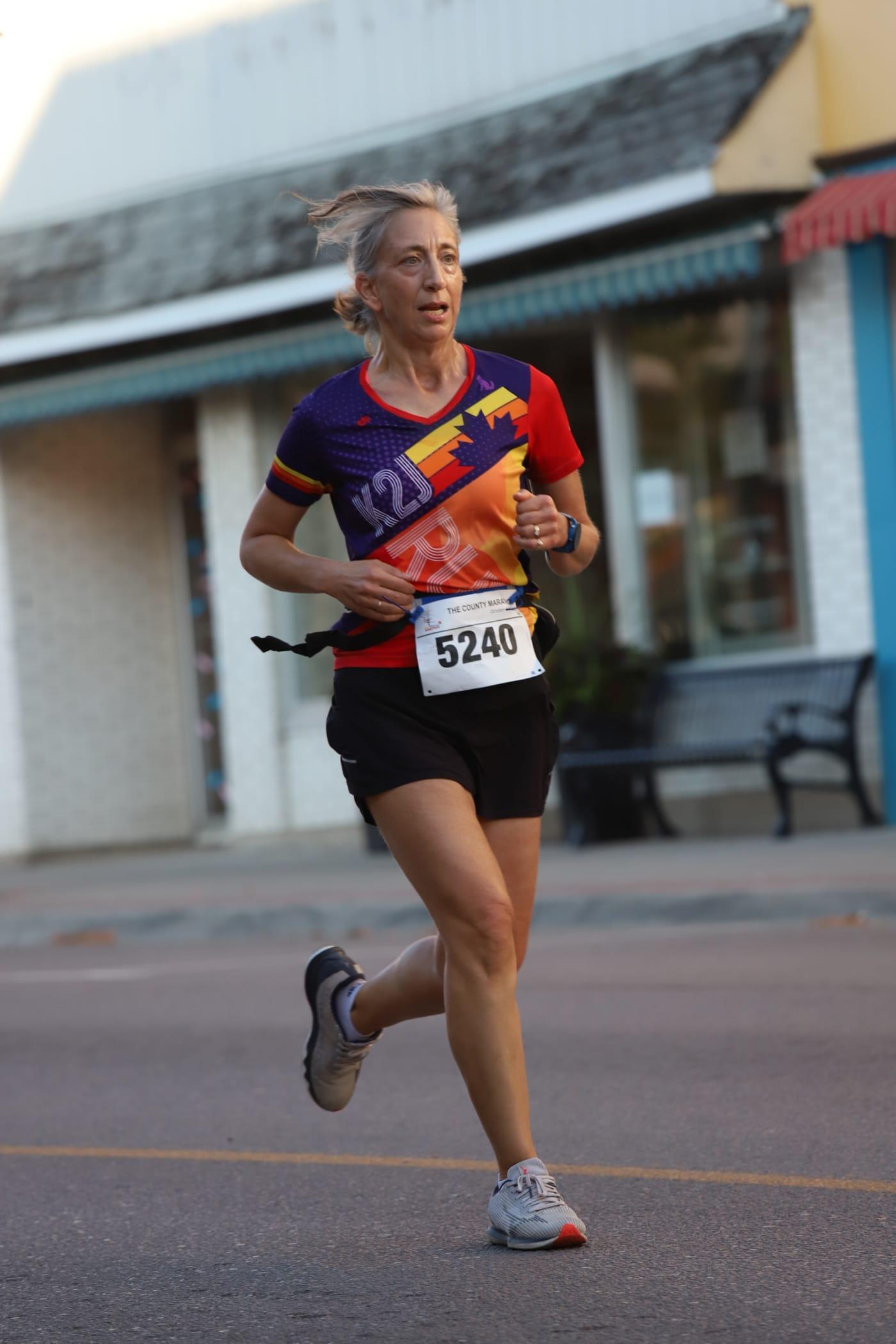
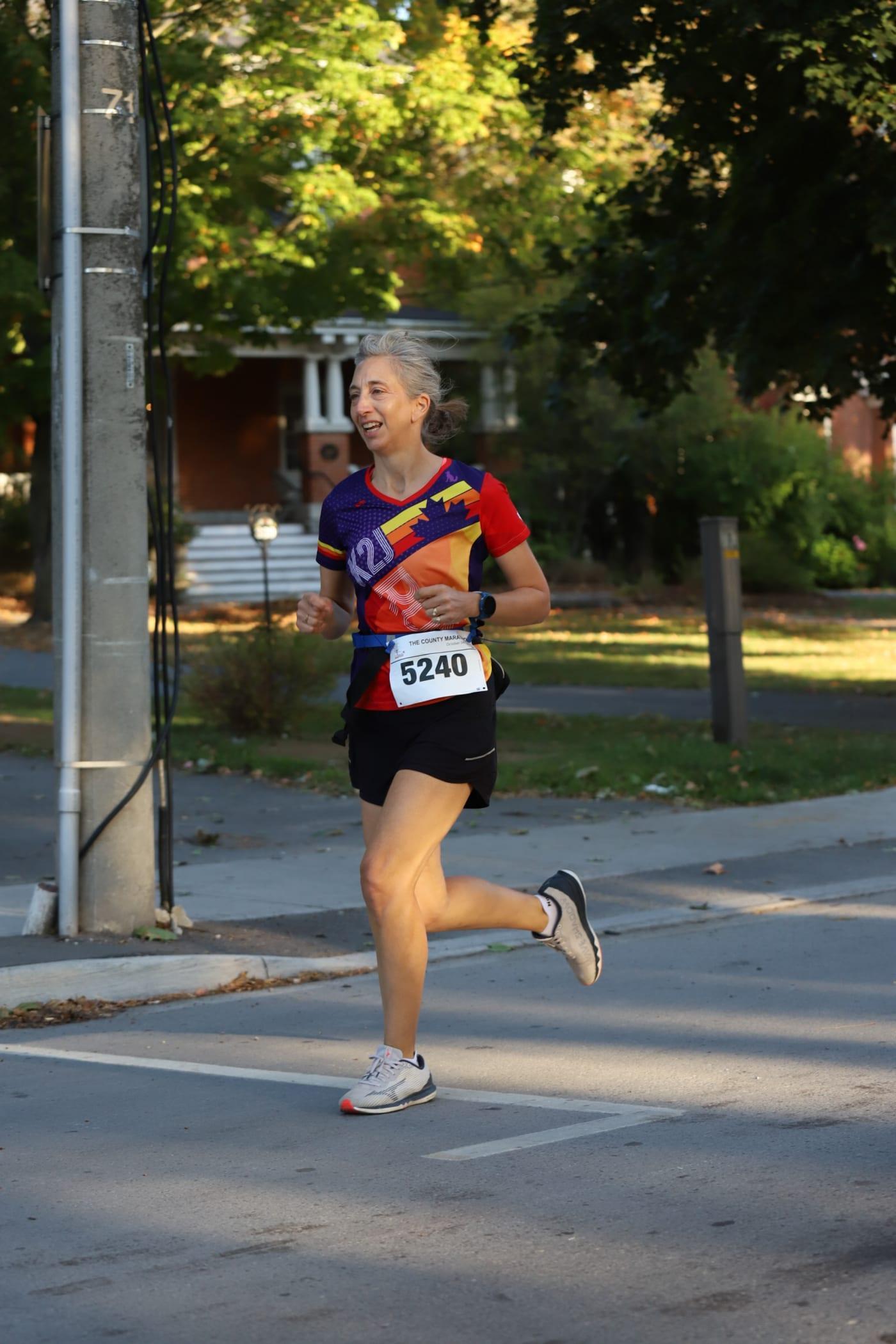
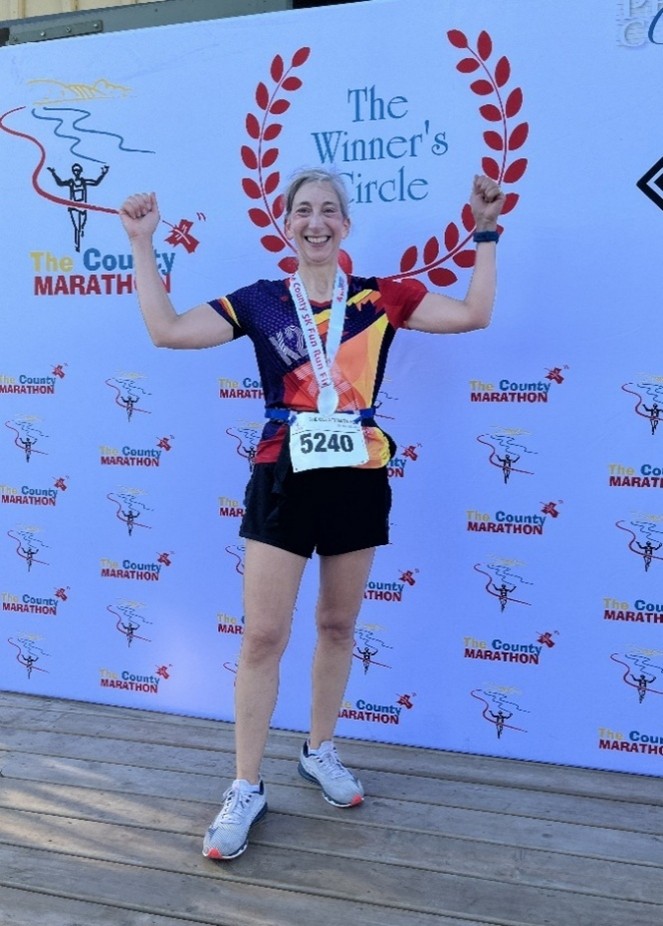
Slowing badly, but still more running than not, that last 5 km was one mind game after another until I crossed the line in 3:55:45, finishing 57th out of 194. Cramping badly, I had to be helped through the finish line area. Ifi then tried to get me to tell her what I wanted to eat or drink, but the only thing I cared about was shade.
That was my fastest marathon in 2.5 years, and my fastest since turning 60.

Ifi enjoyed the 5K event, which she finished in 25:16, finishing an amazing 14th overall out of 300 runners. And, from what she could tell, 1st in her age group for the first time. (This inaugural 5K did not have individual timing chips. The race director has said next year’s race will.)

What I liked about the County Marathon
There was a lot to like:
- It’s a beautiful course at a great time of year. Cameron nailed it with his positive review, even though he ran out of water at 26 km/16 miles!
- In my case, the organization and water stops couldn’t have been better. The volunteers were also exceptional. As much as I like Bouge Bouge Verdun, a lot of the volunteers there were adolescents or young adults. Most of the volunteers here were older adults, and they were first-rate. I never missed getting fluids; something that can happen with a crush of people all grabbing fluids at the same time.
- Prominent kilometer markers at every single kilometer. You really feel like you’re making progress when you see one of those every few minutes.
- Porta-potties at every water stop! I mean, there were 17 of those suckers. I didn’t need one, but I also never felt the tiniest bit stressed about having to find one!
- BioSteel is interesting. It’s light and sweet, but with no sugar. I ended up liking the stuff; I can’t say how effective it was.
- A surprising amount of crowd support. Unlike St. Lawrence, you run past a lot of country houses, with folks out cheering you on, even in rural areas – which is nice. And I got extra support from runners at exchange zones for the marathon relay and when I ran past the half marathon start line – that race started five minutes after I passed the line. It was nice to have more experienced runners around, particularly near the end.
- Like the other courses, it’s also a Boston qualifier and is well measured.
- Great t-shirts, top quality, and a big medal.
What could be better
Despite my enthusiasm, I noted a couple of small things. The course website said a couple of things that didn’t quite pan out:
- Gels were supposed to be available at every water stop. I intentionally left one back at the hotel, hoping to grab one on the course. I did, but I only recall seeing them twice. I suspect there were more that I didn’t see, and some of the stops may not have enough volunteers to actively give out water, BioSteel, and GU. If that’s the case, maybe they should just change the wording to something like “at request.”
- No chocolate milk at the finish, as advertised. They had other normal stuff – fruit, protein bars, etc. Very minor quibble.
Also, there were no timing mat clocks that I could see. This would have been nice at the half marathon point.
Finally, this isn’t really a quibble given that the heat was exceptional for October (as it was in 2023), but the Boilermaker standard of having so much ice available on a hot day was so helpful to runners.
Postmortem
So, I made a lot of changes along the way to finally running a better marathon. One of the challenges about making so many changes is identifying what helped the most (if at all). What was it that worked so much better? Could it be:
- Training – My training efforts increased, starting with the Bouge Bouge marathon “tempo run” and last-minute adjustments to my plan. (I’d like to think this is the biggest reason, along with pacing).
- Pacing – Finally giving into the notion of not going out too fast, I tried to think in terms of “train hard, race easy.” The slower pace definitely helped.
- Shoes – I loved the Adidas Adizero EVO SL. I’ve never liked a shoe so much on downhills, the impact was absorbed. So comfortable. I noticed they were still comfortable getting out of the elevator after the marathon. They aren’t the lightest shoes, and I can’t say they were faster than my previous racing shoes (such as the Vaporfly), but these really worked for me.
- Preparation – I went back to serious carb loading for four days, plus drank some electrolytes the night before.
- Caffeine – I consumed 110 mg total with the gels starting at 11 kms/7 miles. I drink some caffeine daily anyway, so it’s hard to gauge the impact.
- Freshness – Surprisingly, my three fastest marathons have all been on debut courses. I’ve never successfully re-run a marathon course. Psychologically, I wonder if not knowing what’s ahead helps me somehow.
 Run K2J