Anatomy of a marathon failure: When the plan doesn’t go to plan
From: Randy Chafy.
I ran the St. Lawrence Marathon (SLM) on April 27, 2024. It did not go well. Most race reviewers want to talk about their success stories, which is what I usually do. But, while many reviewers also talk about their challenges, not many cover their utter failures. I mean, who wants to read about some dude hobbling along in a world of pain? Is that a race you’re going to want to run? Well, my little tale of woe is going there, but it’s not really about the race (which was great, btw), but about the mistakes I made along the way. While I hope some readers will get something out of this, writing is also cathartic for me — and will have to serve as a postmortem … for the next marathon.
Note: I run miles, but I’ve also converted the distances to kilometers.
Background
I turned 60 in August. That’s not really a great birthday, but I wanted to prove to myself that I still had something left at the big 6-0. A few weeks after my birthday, I got some unwelcome news: I ran a good marathon at St. Lawrence in 2023 (in 3:44:46) and BQed by more than 5 minutes. I was thrilled to have qualified for my first Boston Marathon. But it was not to be. Entrance levels broke all-time records, and the Boston Athletic Association (BAA) decided to draw the cutoff line a mere 15 seconds faster than my finishing time. The way the BAA determined the cutoff for 2024 was problematic, reducing the number of qualifiers by 1000 runners without explanation, but I won’t dwell on that. There was no recourse for me: I would not be getting a bib.
So, how to make this turn of events into a good or, at least, a “better” thing? I decided to give the qualification effort one more try. I thought about how that would feel: being able to thumb my nose at the BAA. So, I did a bunch of math, researched the number of Boston qualifiers in 2023-24, and ultimately decided that — to be safe — I’d need to target a qualifying time of 10 minutes below the BQ standard. That meant I’d need to run around 3:40, which became my new goal.
To achieve this new standard, I decided to go back to the St. Lawrence Marathon. My experience there in 2023 was ideal, and I was hopeful that the point-to-point course would finally provide favorable winds. There was slight eastern wind in 2023, although western winds had prevailed in previous years. I also knew that the race was scenic, well organized, and with surprisingly good crowd support. On that point, this year’s event was just as good as last year’s, if not better. I’d still recommend this race to anyone.
The Plan
With all that decided, here was my three-point “foolproof” plan, with an emphasis on “fool”:
- Set an ambitious pace: In my two previous marathons (see SLM2023 and TWM2022 for my race reports on those), I set a reasonable pace target, expected to slow down, and then followed a fairly orderly pattern of slowing to the finish. I hit the wall in those marathons around 22 miles (35 kms), but I held on. In 2023, I was hoping for a BQ of under 3:50, and every second below that would be gravy. So, I targeted my training at 3:40 pace, but I often was closer to 3:38 in my SOS (“something of substance”) runs, referring to speedwork, strength, tempo, and long runs. My pacing worked perfectly, and I finished just under 3:45. For this year’s race, because I wanted to finish in 3:39-3:40, I decided to target 3:32 pace for my SOS runs. This would be challenging, but I felt I had no choice if I was going to reach my goal — as I told my wife, “This plan will have me red-lining it.”
- Use an advanced plan: This would be my third marathon using the Hansons Plan. See above for the links to my two previous experiences with Hansons. I was comfortable with this plan and felt I was on a logical progression to improvement. Consequently, having used the Beginner Plan for my first marathon and then, for my second, the Beginner Plan plus another 3 easy miles (5 km) a week, I felt well-suited to up my game to the Advanced Plan. I even patted myself on the back for finally becoming an “advanced” marathoner.
- Protect my body: I’ve had a number of injury issues in previous years. Over the past year, my left knee has been the biggest challenge, complemented by a painful bunion. For the first six weeks or so of my training, my knee got so bad I could not straighten it in bed. I had to sleep in the fetal position, often aggravating the bunion! Making it to the starting line seemed increasingly unlikely. To protect the knee, I chose mostly flat routes for my entire training cycle; hill running just aggravated it more. St. Lawrence is a slightly net downhill course, with a fairly mild elevation gain profile (152 meters). Protecting the knee seemed sensible, right? Well, it was until it wasn’t….
The Race
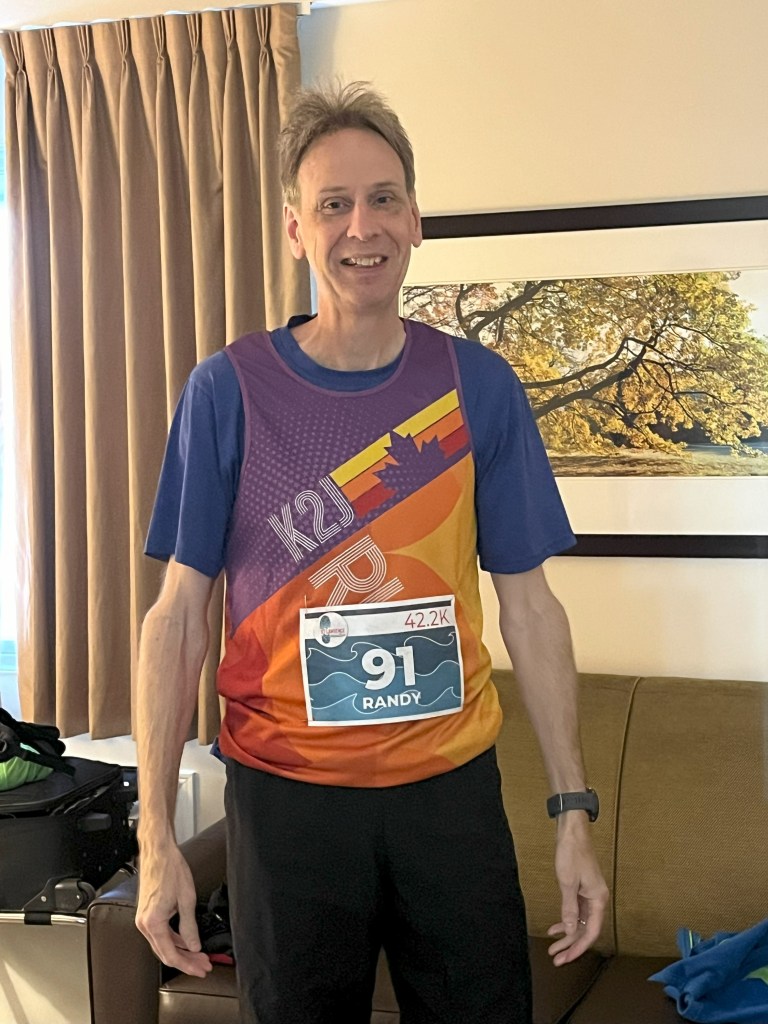
My prep for the race was virtually identical to my 2023 race, including what I ate, our hotel, etc.; I tried to control all those little variables. And my race fueling was essentially the same: the gels, the fluids, sodium intake, etc. I wanted no surprises. But I couldn’t control everything, and I needed to be prepared to adapt (hint: I wasn’t prepared).
One of my biggest pre-race worries was the weather. I had promised myself I would not attempt another point-to-point race into the wind. If necessary, I was prepared to call it off and run a different race the following weekend. But the race-day forecast appeared promising, if confusing. When I checked the weather for Cornwall, Ontario (later learning that this wasn’t a good indicator or even located in Cornwall), the indications were for essentially calm weather for most of the race, followed by a neutral southern wind starting around the three-hour mark. Actual conditions were much more challenging. Temperatures were near ideal, hovering around 5-10C for the first half marathon and gradually getting warmer. But I faced an unpredicted, steady, and sometimes gusty, eastern wind — especially noticeable until the 15-mile (24-km) mark. By then, my race was essentially over.
For much of the first half, which snakes through a scenic recreational path, my pace felt okay despite the headwind. After the 9-mile/14-km mark, the conditions changed a bit. The race entered the Long Sault Parkway, which is a 10 km stretch of very gradual but long hills. The course is more open at this point, and the wind was getting more noticeable. I stubbornly persevered, keeping exactly on pace, to my peril a few miles later.
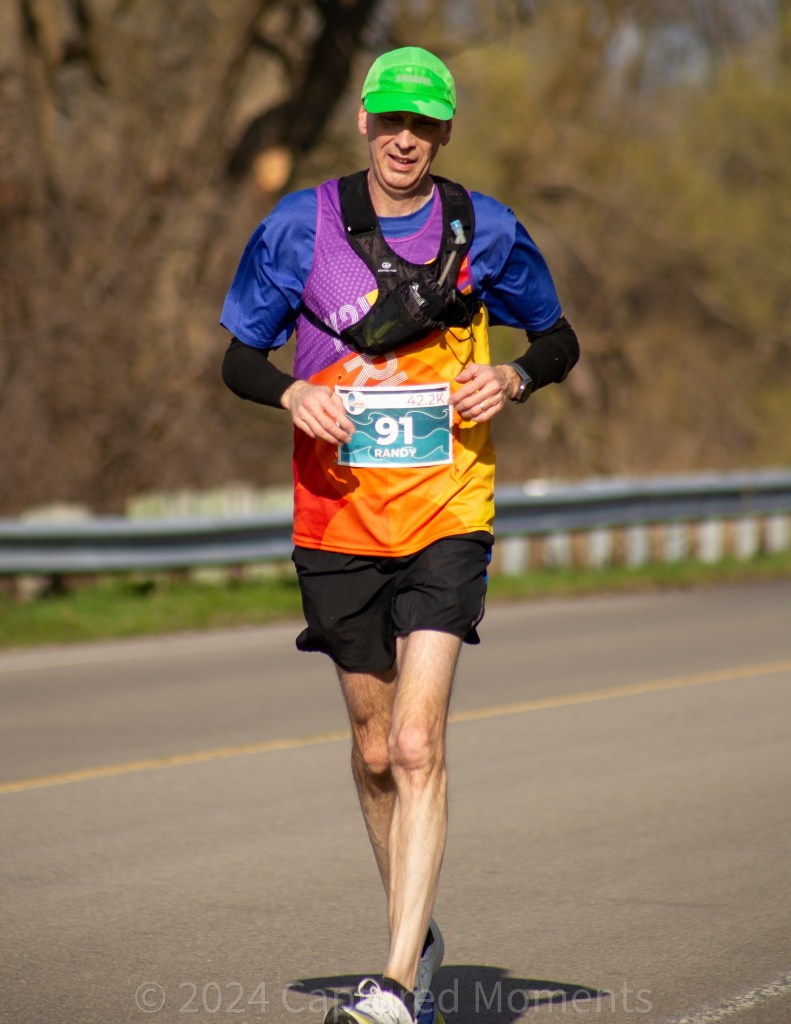
My target was to hit the half in 1:47:30, followed by a slower, but hopefully orderly, second half of the race. I came through the half marathon in a perfect 1:47:31. But things were not well. I noticed my pace slowing after 12 miles (19 kms), dropping 10 seconds just before crossing the half-marathon mat. Shortly after that, I noticed my hip flexors were getting quite sore, just before coming into a series of short, but steep hills. And I got my first leg cramps, the first of many to come. I’m used to getting let cramps in marathons, but — unlike last year — I wasn’t able to pick up the pace at all after getting them.
At some point during the hill portion, I started to hit the wall. By the time I finished 17 miles (27 kms), I was stick-a-fork-in-me done. But I still had 9 miles (14 km) to go! I was reeling from the disappointment and the leg pain. I started to walk-jog — the kiss of death. I was concerned my wife, who was in the 10K, might be worried when she didn’t see me. At that point, I felt the race was over for me, and I thought it would be better to just get off the course and recover.
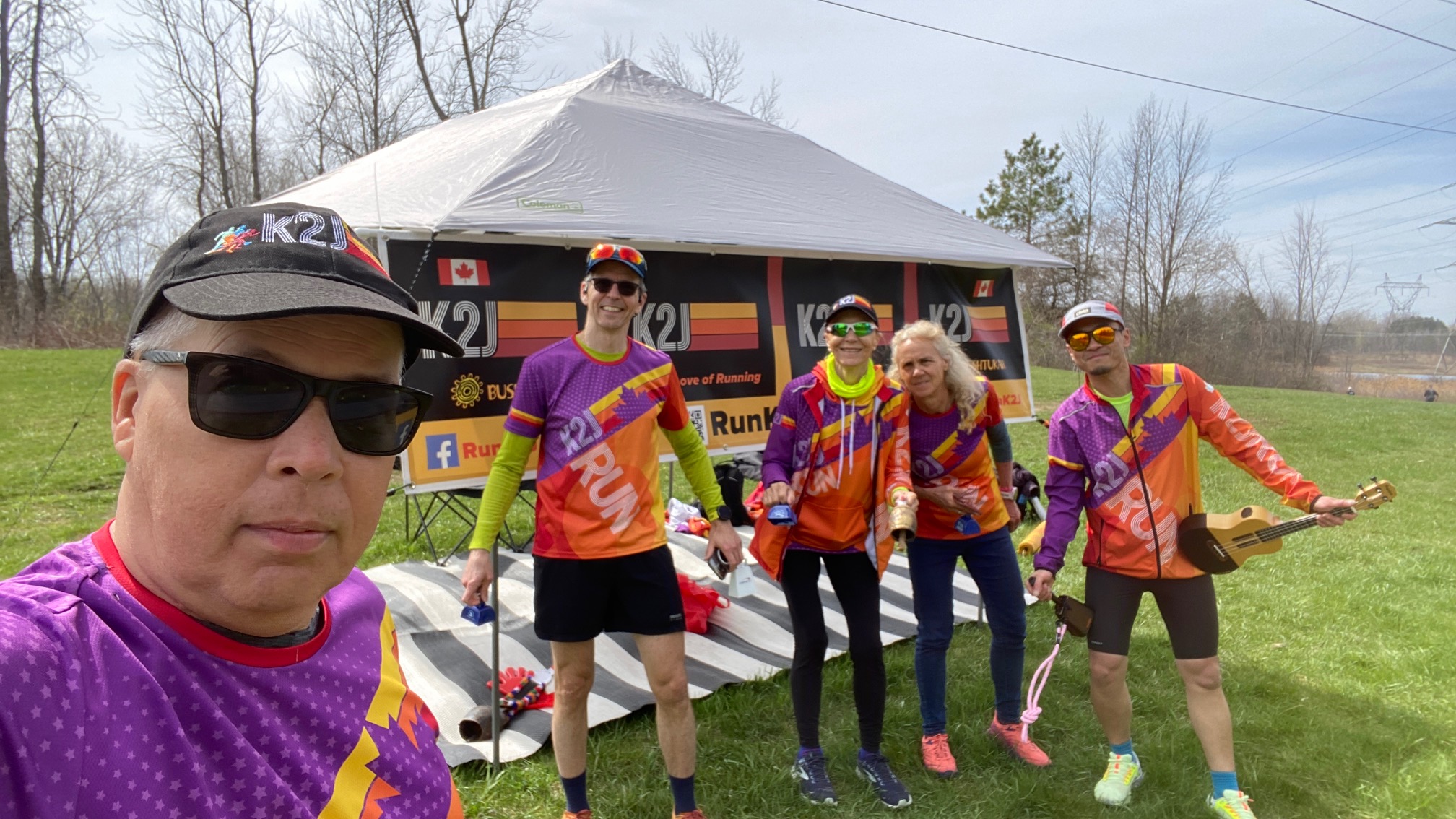
I decided to hobble my way towards the cheering section of my running club (Run K2J) at 21 miles/34 km and just ask for a ride to the finish line. As I approached my running buddies, I was so embarrassed. I didn’t want to DNF, but I didn’t see the point of continuing either. I was conflicted, and I’d like to think I would find a way to keep going before accepting a ride. I didn’t get a chance to think about it — one of my Run K2J buddies, Mike, had other ideas: he quickly got me moving again and together we jogged to the next water station. At that point, I committed to finishing, but once I got moving again, it was the classic death march: run a few steps, walk, repeat. Bad as I felt, I targeted 12-minute per mile (7:30/km) pace; at least it gave me a goal. I could barely keep it up, but I did until the finish. I even passed a couple of marathoners feeling worse than me.
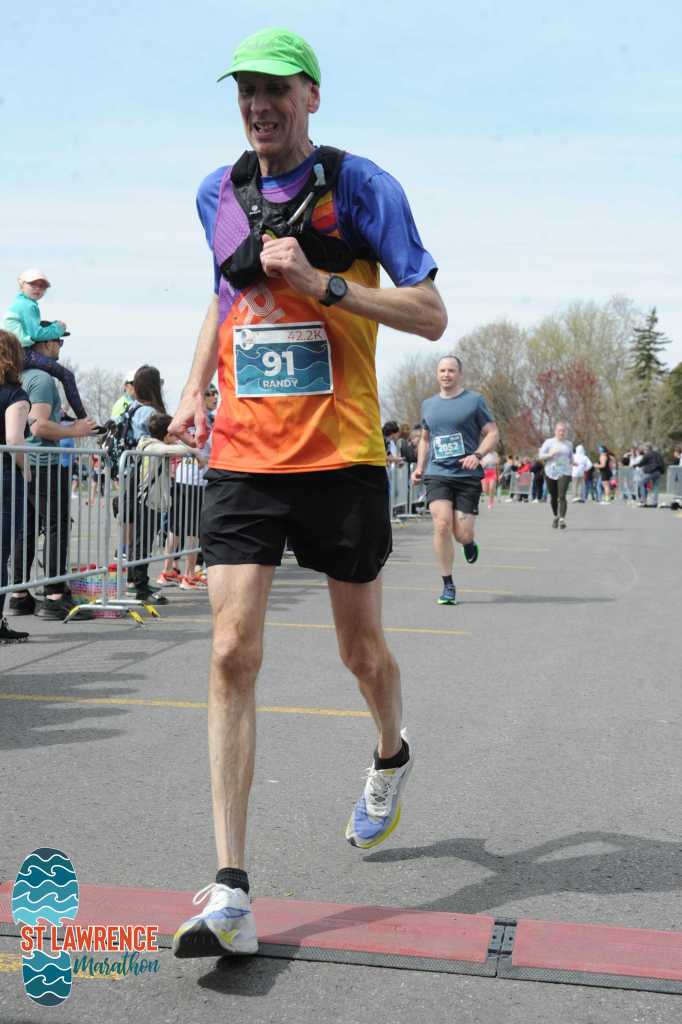
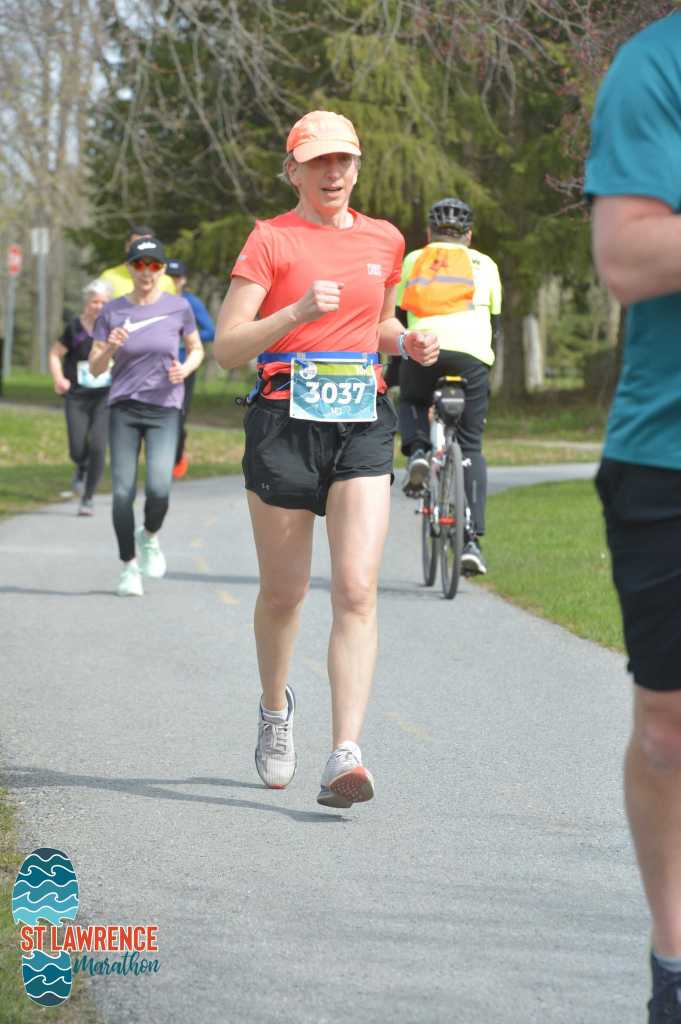
Right at the finish line, a photographer was taking pictures. I had maybe 30 feet to go and both my legs cramped badly. I normally would have stopped, but instead staggered over the line in 4:08:11, clutching my legs, almost falling over. The finish-line photographer was kind enough to snap a momentary photo without me grabbing my leg (see the last photo).
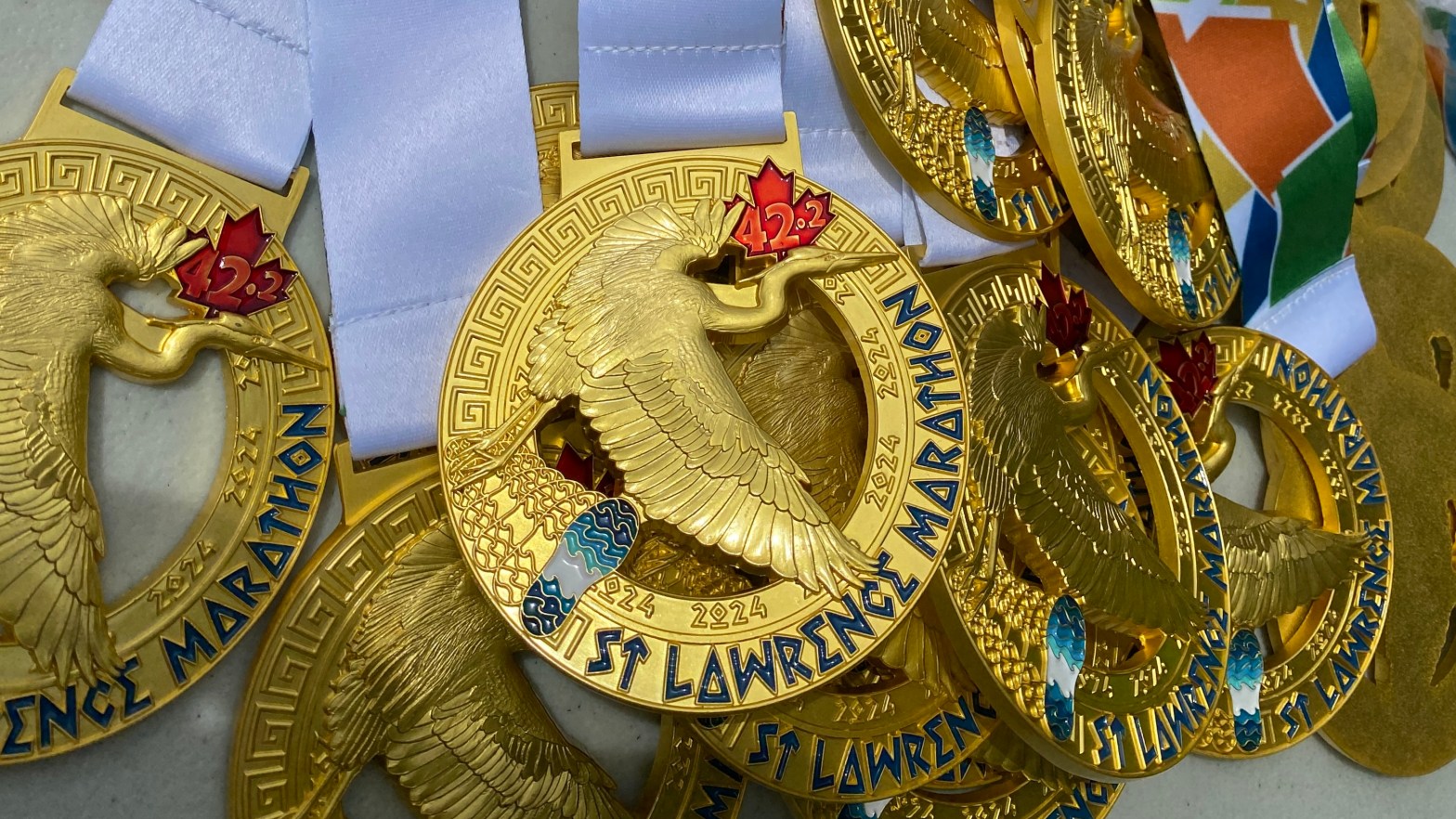
In the end, Mike and RunK2J helped to save the day for me; I got a big-old medal that I wouldn’t have gotten otherwise. Thanks, Mike!
What went wrong?
Mistake #1: Being too ambitious for the conditions
When I started my plan, I wanted to hit 3:32 finishing pace for my race-pace tempo runs, which meant I needed to hold an 8:05 per mile (5:01 per km) Garmin pace. I can handle faster paces; my running history shows that I tend to run faster, in terms of equivalency, right down to the 5K (or even shorter distances back in my college/university days). Back in October, I ran a 1:42:05 for a half marathon at the Toronto Waterfront Marathon (TWM), so I felt I could handle this faster training pace. And I was right, but only to a degree.
From my earliest tempo runs, I questioned my pacing. I tend go a little bit faster than my training targets, but I never got comfortable with my tempo (and later strength) targets. I always finished my 7-9 mile/11-14 km tempo runs at my target pace of 8:05 per mile (5:01 per km), of which Hansons adds 3 miles (5 km) of warmup and cooldown. But unlike my previous training cycles, within the context of the higher mileage weeks, I felt that I was “pushing” it just to keep up that pace. I would start off at 8:05/5:01, find myself drifting up to 8:15-20 (5:08-11), work back to 8:03/5:00, drift up again, etc. Although I would finish on pace, it was an uneven effort. That was my pattern; I just wasn’t locking in comfortably at the faster pace.
Consequently, about six weeks before race day, I faced reality and realized my current pacing target of 3:32 (8:05/5:01 pace) was unrealistic. So, I revisited my pacing and came up with a plan B: target 3:35 pace (8:10/5:04 pace) and hope for a slightly faster pace in the second half. My training felt better at this pace, less consciously “pushed,” but still just on the edge of comfortable.
In the end, even 8:10/5:04 was too ambitious for this particular race. I tried to convince myself that I could handle that pace, and maybe I could have under different conditions, but I could not sustain that into an increasing headwind. Nor could I sustain it through the hilly sections. Was I undertrained? Maybe, but I think I trained the wrong way….
Mistake #2: Choosing the wrong training plan
I was excited to start the Hansons Advanced Plan. I thought this would be my ticket to a solid marathon. Starting just after Christmas, I methodically increased my mileage, even exceeding the first week of mileage for the plan. I then followed the plan, increasing my mileage, while also increasing my SOS pacing targets — which were set at 3:32 marathon pace.
By week 2, I was at 41 miles (66 km), and the weekly distance just went up from there. This differed greatly from the Beginner Plan, which uses a much more gradual and milder ramp-up. The Beginner Plan only reaches 57 miles (92 km) at week 15, just before the taper. In contrast, by week 9 on the Advanced Plan, I was at 57 miles (92 km), with some 7-day-cycles pushing beyond that distance. Clearly, lots of marathoners can handle that kind of mileage, but my challenge was fourfold: distance+pace+fatigue+weight loss.
In terms of distance and pace, I managed to hang on to the Advanced Plan through my first 9 weeks of the 16-week training cycle. I was hitting all my physical targets. I was handling the speed work with my running club (Run K2J) just fine, although those workouts seemed to be getting into my head, and I longed for the slower strength work to come. By week 9, I was mentally reaching a threshold. Although I’m very familiar with the concept of “cumulative fatigue,” I was not prepared for the constant level of fatigue I was dealing with. It was just becoming 24/7. Even my single weekly day off didn’t seem to help much. I can’t say exactly what broke me, but I was having a difficult time with increasing distances (knowing I still had months to go and harder challenge in front me), coupled with the much faster pace I was trying to hit. But what finally ended the Advanced Plan for me was the weight loss. I lost more than 10 pounds in a couple of months. I did not lose that much in previous plans. That scared me, and, coupled with the constant fatigue, I just said I’m done with all that.
The problem is, as Luke Humphrey himself (author of the Hansons Plan book) warned against, if you bail out of the Advanced Plan midstream, you just end up intersecting with the Beginner Plan as its mileage is rapidly increasing. So, essentially, I just ended up running at the same level of distance for another couple of months, only avoiding the increased mileage that would have come in the final weeks of the Advanced Plan. Even this was a mental boast. But my fatigue levels and my weight never really recovered — everything just plateaued. And I had reached my limit: in 2023, I added in a few more easy miles per week to the Beginner Plan, but I had no energy for that. I just stuck exactly to the plan, hanging on until race day.
Having reached mental burnout and feeling overtrained, and wanting to keep my weight reasonable, I reworked the last three weeks of the Hansons Plan – which were 50, 49, and 24-mile weeks (80, 79, 39 km). Although I followed the Hansons taper for my two previous marathons, I replaced those weeks with 40, 30, and 13 miles (64, 48, 21 km), shortening all SOS runs. In hindsight, this was another mistake. The change was too drastic, and I don’t think it helped me when the time came to gut out those final miles.
Mistake #3: Underestimating the “forgotten” hills
This one’s a little different. I ran this race last year and had a great understanding the profile. I knew there would be hills and exactly where they would be. This knowledge worked against me, believe it or not. Last year, I had a great race, exceeding my expectations. By the time I got to, and worked through, the hilly portion, I was thinking “no big deal.” I was feeling strong and good about life. This year, I was underprepared for the hills. My hip flexors and quads sent me that message earlier than expected, and I quickly lost pace after that process started. How could that happen? Because last year was my first SLM race, I did some research and learned that the hills just past 15 miles (24 km) were the toughest on the course. One runner wrote they were “brutal” (he finished in third place overall). So, I took his warning seriously. I made sure I included reasonable hills on nearly all of my longest runs and many of my tempo runs. It made sense to duplicate those runs this year, but I didn’t — why?
My knee is the main culprit. As I wrote above, I’ve had recurring issues, and my first six weeks of training were difficult and worrying. I was using the same shoes I’ve always used (either a Saucony Ice shoe for winter weather or my traditional go-to shoe, the Mizuno Wave Rider), but my knee was worsening. I did some research on the softest training shoes around and got myself a pair of New Balance 1080 shoes, which are like running on clouds. Oddly, a day or two before getting those shoes, my knee started to feel a bit better. I still don’t know to what degree my new shoes versus my weight loss — or a combination of both — “solved” my knee problems, but it quickly improved. As I sit here today, two days after the marathon, my knee feels fine, and I had no pain in the actual race. In my training, I easily could have reintroduced hill training around the 8-10 week mark, but I didn’t. While I didn’t want to risk reaggravating the knee, I also wasn’t concerned about the hills. Big mistake.
Knowledge is a funny thing. Part of the reason I didn’t do any hill work is because I had mentally whitewashed my own experience with the SLM hills. Everything went so well last year that I failed to remember how seriously I had taken the hills in my training and my mental outlook on race day in 2023. It was like I’d already “won” that battle. I wasn’t prepared because of my previous success.
The takeaways
Lesson learned #1: Adapt my pace
I need to learn to back off my pace if the conditions are getting more challenging; be patient and maybe make up that time later. Instead, I stubbornly pushed through it and hit my half-marathon target, but marathons can take back those kinds of mid-race struggles. I should have been feeling strong as I entered the hills at 15 miles (24 kms); instead, I was hanging on to an even slower pace — in part succumbing to my self-inflicted pressure of qualifying for Boston. I did not adapt well enough to the conditions, or the signals I was getting, maintaining an overly ambitious pace through increasingly challenging conditions. Saying “adapt” is one thing, actually implementing it is not easy — and I will have to build this into future training cycles to get more confident in my pacing. As my wife put it, I need “more mental flexibility.”
Lesson learned #2: Set reasonable expectations
This one is tough to accept and to write down: forget about Boston. I like targets and challenges, but the marathon is a special beast. I cannot train and race with a cloud of pressure surrounding everything I do. It not good for me or anyone around me. I BQed in 2023; no, I didn’t get the bib, but a lot of people would be happy with just the BQ. I spent months feeling angry about that situation. Rather than celebrate the BQ, I focused on the cutoff disappointment, which I had no control over. While my first attempt at qualifying (breaking 3:50) was one thing, I can’t succumb to the vagaries of the BAA’s qualifying whims. Move on! If I’m going to run a decent marathon in the future, I’m going to need to feel much more confident and relaxed about my expectations. I felt stressed before my SLM run in 2023, but I set realistic targets and felt everything I did on the second half was a “win.” I went more than five minutes faster than my goal time, just rolling along with it. This time around, my stretch target and real target were the same thing; there was very little flexibility — and I was just a big ball of pressure before and during the race. Having said all that, I felt I had to give it a try, failure notwithstanding.
Lesson learned #3: Longer is not better
By longer, I am referring to duration: the number of months spent training. I got by just fine with the Hansons Beginner Plan, which starts with several weeks of easy base training and emphasizes the last two months of training. For me, trying to train at 40-60 miles for 16 weeks (with several more weeks of speed and tempo work) was just too long, especially given my faster target pace. I was burned out midway through my training cycle and never really recovered.
Lesson learned #4: Respect the hills, even smaller ones!
Anyone who thinks they can tough out hills just because they are training faster is probably going to struggle when those hit. I wasn’t in nearly the shape I needed to be to handle the SLM course. I should have been gaining confidence through the hills, but I was rapidly losing it.
Lesson learned #5: Don’t rely on the weather forecast
I still don’t know exactly how or why that forecast was so wrong. It was fine for the finish in Cornwall, but this race started out of town and was right on the St. Lawrence seaway, with many stretches over open water. If I had to do it all over again, I definitely would have skipped this race. Even if I would have run a smarter race, I doubt I would have been faster than last year.
Lesson learned #6: Stick with a plan that works
The Hansons Plan has been great to me. It got me through three marathons, two of them beyond my expectations. And I will likely continue to use it going forward, but definitely not the Advanced Plan!
One of the most controversial aspects of the plan is the limited 16-mile/26 km long run (which alternates biweekly with a 10-mile/16 km) long run). Many marathoners argue this is too short, and that for mental and physical reasons, you need to get up to 18-20 miles (29-32 kms). The Hansons Plan book argues that the 20-mile run is not worth it – that you give up too much and literally damage yourself; then you don’t recover enough. This forces you to take it easier just to recover. Others disagree.
While I take the point that a longer run might require more recovery, in my case, I’m starting to think the benefits might be worth the risk. I’ve hit the wall in every marathon I’ve run, to varying degrees. I’m tall and thin, and I seem to run out of glycogen easily (despite four days of carbo-loading, followed by sucking down gels every 3.3 miles/5.3 kms during the race, in addition to some Gatorade). This also occurred in my recent training (my first 16-mile/26 km run), and it usually occurs once or twice in my marathon training cycles. It’s been a few years now, but I’ve even run into a version of the wall in a couple of half marathons – briefly walking near the end of those races. For me, it can be a very rapid decline, occurring over the span of 1-2 miles. So, I’m starting to think that I should try to stretch out my long runs a bit to work out my fat and glycogen adaptations.
Final thoughts
Despite everything I’ve written above, I still have some lingering questions that I need to work out in the coming months:
- Why did I hit the wall so hard this time around? Going out too fast, lack of hill training, and questionable overall strength (age creeping in?) are easy to point to. But it’s not like I didn’t put in the work for several months. Where did that go?
- Were shoes a factor? I used my Vaporfly’s, which had maybe 75 total miles (121 kms) on them, including last year’s successful marathon. They never felt good this time around, and I have to wonder if the unique characteristics of the shoe contributed to my cramping and leg pain. I briefly considered using my Hyperion Tempos, which are a completely different feel, closer to a traditional racing flat. I ran my recent 1:42 half marathon in the Tempos, and my Toronto Waterfront Marathon in 2022, but I felt that the firmer ride would catch up with me.
- Can I improve my nutrition? The web is full of ideas on how to manage carb-intake and the wall. Some alternatives include things like slow-release carbs, eating a bigger breakfast, or limited training without fueling.
Finally, while writing this report, I couldn’t help but reflect on how I’ve been chasing the Boston Marathon for two years now – and living with the disappointment of just missing out. Maybe it’s just my vanity speaking, but I wanted that damn Boston Marathon jacket! Conversely, I realized something very important: in my age group, lots of runners are walking around in those jackets, after having qualified with times approaching 3:50 (for 2022 and 2023) or slower times before that (up to 3:55 between 2013-19, or 4:00 between 2003-12). Would I trade my PB with one of those runners if it meant I’d get that jacket and the chance to enter Boston? No way! What matters more is my personal achievement. It’s just taken me a long time to accept that.
Editors Note: Thanks for the kudo’s in the review. Having great colleagues there on race day is invaluable, and even the workouts leading up to the actual race day helps build confidence and dials in any training plan! Great to have everyone there at the St Lawrence Weekend run, and you can always get by with a little help from your friends.
 Run K2J